Empty Villages of Garhwal
When the Mountains Remember Their People
“A village may fall silent, but it never forgets. Behind every locked door, every abandoned field and every empty courtyard lives a story of the people who once called it home.” – Ashutosh Singh Bisht
There is a strange kind of silence in some villages of Garhwal.
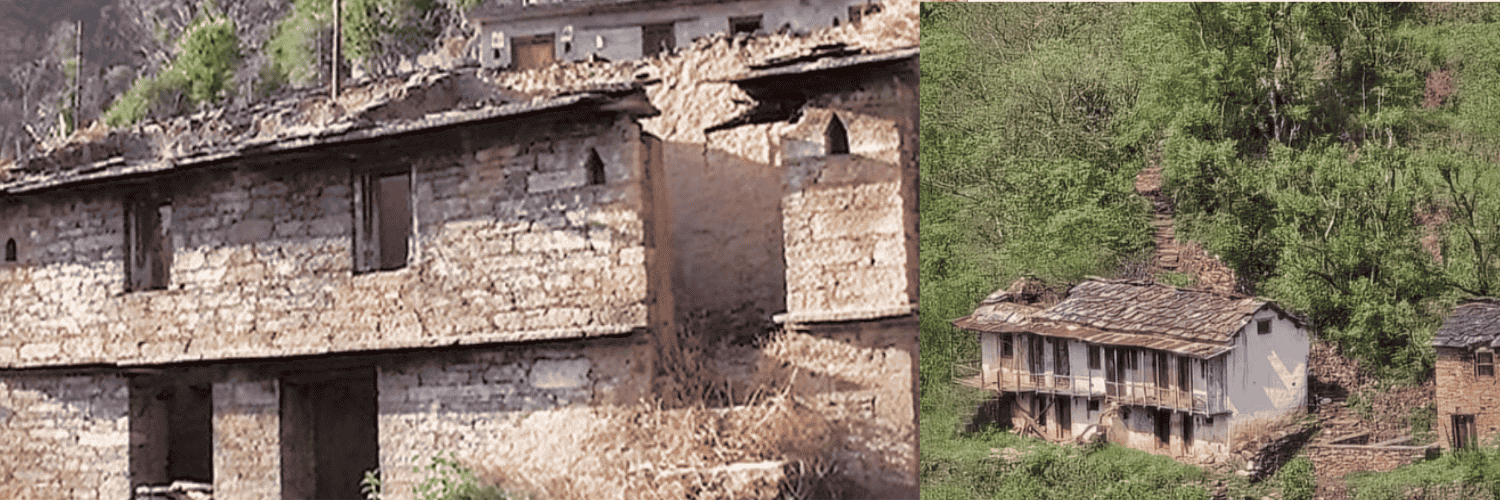
The houses are still standing. The old stone walls remain, weathered by time but still holding their place. The village temple stands where it has for generations, while terraced fields continue to stretch across the mountain slopes, just as they have for centuries.
But something is missing: people.
A door that was once opened every morning may now remain locked for months. Courtyards where children once played may be covered with weeds. Paths that once carried villagers to their fields may now be used only occasionally.
To a visitor, such a village may simply appear quiet. But for someone who grew up there, the silence can feel very different. It can feel like walking through a childhood memory a place where the houses, temples, fields and paths remain, but many of the voices that once brought them to life have slowly faded away.
When People Began to Leave
People from the mountains have travelled outside Uttarakhand for work for generations. Garhwalis have served in the armed forces, worked in cities, studied outside the region, and built lives far from their ancestral homes.
Migration itself, therefore, is not new. What has changed is its scale and permanence.
For many families, the decision to leave is not really about wanting to abandon their village. It is about finding opportunities that may not be available there. A young person wants access to a good college. A family needs better healthcare. Someone is looking for a stable job. Parents want their children to have opportunities and choices that they themselves may not have had.
These are reasonable dreams.
The problem begins when leaving becomes the only practical choice.
The Uttarakhand Rural Development and Migration Prevention Commission has identified rural migration as a serious concern. Its comparison of the 2001 and 2011 Census data found an absolute decline in population in Pauri Garhwal and noted that many mountain villages were being left with very small populations.
As more people leave, the village slowly begins to change. Houses become locked, fields are cultivated less often, and the sounds of everyday village life gradually become quieter.
A Village Does Not Become Empty in a Day
A village rarely becomes deserted overnight. It happens one family at a time.
One house is locked because the family has moved to Dehradun. Another family leaves for Delhi. A young couple decides to settle somewhere with better employment opportunities. Eventually, children who once returned during school holidays stop visiting as often because their lives are now rooted elsewhere.
The older generation often remains behind. They continue to look after the house, the fields and the family temple. They know every path, every water source and almost every family in the surrounding area.
For them, leaving is not easy.
This is why an empty village cannot be understood simply through statistics. The Census of India recorded 331 uninhabited villages among 3,473 villages in Garhwal district in 2011. The same Census recorded a negative decadal population growth of 1.41% for the district between 2001 and 2011.
Those numbers tell us that something significant happened. But they cannot tell us what it feels like to stand outside a locked ancestral home.
The Story of Pauri Garhwal
Pauri Garhwal perhaps represents this change particularly clearly.
Spread across mountains and valleys, the district has hundreds of villages, many of which have traditionally depended on agriculture, livestock and small local livelihoods. The official Census records a large number of individual villages across the district, reflecting the scattered and diverse nature of settlement in the region.
But difficult terrain can also make everyday life challenging. A village may be several kilometres from the nearest market. Reaching a hospital may require a long journey. Higher education often means moving to a town or city, while employment opportunities within the village can be limited.
For a young person, the city can therefore seem less like an escape and more like the natural next step.
And when the young leave, the village becomes older.
What Happens to the Things People Leave Behind?
The loss of population affects more than houses. It also affects the everyday traditions and knowledge that make a village feel alive.
Many aspects of Garhwali culture were never formally taught. Children learned them simply by growing up around their elders.
They learned which festival was celebrated when. They heard stories from their grandparents. They picked up local words and expressions. They watched elders prepare traditional food, work in the fields and participate in village ceremonies.
Much of this knowledge passed naturally from one generation to the next.
But what happens when those generations no longer live together?
A child growing up in a city may know that their family comes from Garhwal without knowing the name of the field their grandparents once cultivated. They may understand Garhwali but speak mostly Hindi or English. They may visit the village during a festival but never experience the everyday rhythm of village life.
This does not mean that their connection with Uttarakhand has disappeared.
It simply means that the connection has become more distant.
When the Fields Begin to Change
Perhaps nowhere is the impact of migration more visible than in the terraced fields.
For generations, these terraces were maintained through hard work. Families depended on them for food and income, adapting farming practices to the steep mountain landscape.
But a field cannot cultivate itself.
When working-age family members move away, elderly parents may no longer have the strength to manage the land on their own. As a result, some fields are cultivated less frequently, while others are left unused altogether.
Once that happens, the landscape itself begins to change.
Terraces that once reflected generations of careful human effort can gradually become covered with vegetation. What was once a productive part of village life slowly becomes part of an abandoned landscape.
This creates another difficult cycle.
When agriculture becomes less viable, more people leave. When more people leave, fewer remain to cultivate the land. And when fewer people cultivate the land, farming becomes even harder to sustain.
Yet, Garhwal Is Not a Story Without Hope
It would be wrong to describe these villages only as places that people have abandoned. There are also stories of people returning.
Some young people are experimenting with farming and horticulture. Others are exploring homestays, local products, tourism and small businesses.
For some, the village is no longer simply the place their parents left behind. It is becoming a place where they can build something new.
The idea of reverse migration has also received official attention in Uttarakhand. The state’s Rural Development and Migration Prevention Commission works on migration-related issues and has initiatives focused on encouraging people to return to rural areas.
But asking young people to return cannot simply mean asking them to live exactly as their grandparents did.
They need reliable internet, good schools, healthcare, transportation and sustainable sources of income.
The challenge is not to take Uttarakhand backwards. It is to make sure that moving forward does not require leaving the mountains behind.
A Village Is More Than a House
When we talk about an “empty village,” it is tempting to think only about empty houses.
But a village is much more than that.
It is the old temple where generations gathered. It is the tree under which people sat together in the evening. It is the stone staircase built by someone decades ago. It is the field that once fed a family. It is the local word that only grandparents still use. It is the story that has been told so many times that everyone already knows how it ends.
These things rarely appear in government statistics.
Yet they are what make a place feel like home.
That is why returning to an ancestral village can be such an emotional experience. Even if someone has spent most of their life in Delhi, Dehradun or another city, there can still be something deeply familiar about seeing the house where their grandparents once lived.
The walls may have aged. The fields may have changed. The village may be quieter than it once was.
But the sense of belonging can remain.
Maybe the Answer Is in the Next Generation
The future of Garhwal’s villages will not be decided by one scheme or one solution.
Better infrastructure matters. So do employment, education and healthcare. But something else matters too: whether the next generation feels that the village belongs to them.
If young people can find meaningful work while staying connected to their villages, the story can change.
A homestay can keep a house occupied. A local business can create employment. A revived field can bring agriculture back to a family. A young person returning home can inspire another to consider doing the same.
Sometimes, change begins with something as simple as one house opening its door again.
The Mountains Are Still Waiting
Perhaps the saddest thing about an empty Garhwali village is that the village itself has not gone anywhere.
The mountains are still there. The old paths are still there. The temples are still there. The fields are still waiting for someone to work them. And the houses still hold the memories of the people who once filled them with life.
Migration has changed Garhwal, but it has not erased its identity.
A village can become quiet without becoming meaningless. An ancestral home can remain empty for years without losing its importance.
Maybe someday, a child who grew up far away will return and open that old wooden door. Maybe they will repair the house, plant something in the field, or teach their own children the Garhwali words their grandparents once used.
And perhaps, slowly, another voice will join the silence.
Because the story of Garhwal’s villages does not have to end with people leaving.
It can also be a story about remembering where we came from and finding a reason to return.
Frequently Asked Questions
Why are people leaving villages in Garhwal?
People leave Garhwal villages mainly in search of better employment, education, healthcare and other opportunities. For many families, migration is less about abandoning their village and more about finding opportunities that are difficult to access locally.
What is migration from Uttarakhand’s mountain villages?
Migration refers to people moving from their villages to towns, cities or other parts of India, often for employment, education or better access to essential services. While migration from the mountains has existed for generations, the scale and permanence of migration have become a growing concern.
What happens to villages when people migrate?
When a large number of people leave, villages can become increasingly dependent on older residents. Houses may remain locked, agricultural land may be left uncultivated, and traditional community activities can become less frequent.
How does migration affect agriculture in Garhwal?
Migration can reduce the number of working-age people available to cultivate terraced fields. As a result, some agricultural land may be cultivated less frequently or left unused, which can gradually change the traditional mountain landscape.
Does migration affect Garhwali culture?
Yes. Migration can make it more difficult for traditional knowledge, local words, folk traditions, food practices and village customs to pass naturally from one generation to the next. However, migration does not necessarily mean that people’s cultural connection with Garhwal disappears.
What is reverse migration in Uttarakhand?
Reverse migration generally refers to people returning from towns or cities to their villages or rural areas. Some people are returning to explore agriculture, horticulture, homestays, tourism, local products and other forms of entrepreneurship.
Can Garhwal’s empty villages become populated again?
Yes, but bringing people back requires more than asking them to return. Reliable employment, healthcare, education, transportation, internet connectivity and sustainable livelihoods can make rural communities more attractive to younger generations.
What can young people do to stay connected with their ancestral villages?
Young people can stay connected by visiting regularly, maintaining ancestral homes, supporting local businesses, learning Garhwali language and traditions, helping preserve family land, or exploring opportunities such as homestays, tourism and agriculture.
Are Garhwal’s villages completely abandoned?
Not necessarily. Some villages have become severely depopulated, while others still have permanent residents, particularly older generations. The situation varies considerably from village to village.
Why are Garhwal’s villages important even when they have fewer residents?
A village represents more than its population. It contains ancestral homes, temples, fields, traditions, memories, local knowledge and cultural identity. Even when fewer people live there, these connections can remain important to families and future generations.
“Perhaps one day, a forgotten door will open again, a field will be cultivated again, and a child will hear the Garhwali words of their grandparents. That is when the mountains will know that their story continues.” — Ashutosh Singh Bisht
The empty villages of Garhwal are not simply places where people have left. They are places that still carry the memories, traditions and stories of the generations who once called them home. Migration has changed the mountains, but it has not erased the connection people have with their ancestral villages. The future of these villages will depend on whether the next generation can find reasons to stay connected and perhaps, one day, to return. The mountains are still there. The old homes are still standing. The fields are still waiting. Perhaps all they need is for someone to open the door again.