Bhotiya Tribe
Bhotiya Tribe is a unique and ancient community of people residing in the high-altitude regions of the Indian Himalayas. Predominantly found in Uttarakhand, Himachal Pradesh, Sikkim, and parts of Nepal and Tibet, the Bhotiya are known for their rich cultural heritage and deep connection to the Tibetan way of life. They are believed to be of Tibetan origin, with many aspects of their traditions, language, and customs closely aligned with Tibetan Buddhism.
Bhotia also spelled as Bhotiya Tribe, is one of the most ancient tribes in Uttarakhand. There are many sub-tribes of Bhotia Including Marcha, Jauhari, Tolcha, Shauka, Jarh, etc. They are one of the best climbers in the country and can reach high Altitudes with zero difficulties.
They are very hostile and mostly speak western Himalayan languages, and they follow Hinduism and Buddhism. They mostly exist in the Almora, Chamoli, Pithoragarh, and Uttarkashi districts of Uttarakhand.

Origin of Tribe
The term Bhotia comes from the Bhot word; this is the traditional name of Tibetan people. The bhotia’s have mongoloid features and are also known as Pahari or hill people; they converse in many languages like Hindi, Nepali, Kumaoni, and Garhwali. They made their houses using mostly wood. Bhotia community has many features, but their best feature is that in this community both men and women are given equal respect and social status.
The six subcategories of Bhotia are Rang, Johari, Tolcha, Marcha, and Jad. Rang and Johari Bhotias belong to the Pithoragarh district. Tolcha and Marcha belong to the Chamoli district, and Jad is mostly found in the Uttarkashi district. In Uttarakhand, they inhabit seven river valleys three in the Garhwal division and four in Kumaon Division.
Religion of Tribe
The Bhotia tribe worshiped Nanda Devi, Pancha Chuli, and Badri, and there is a temple dedicated to the Goddess Nanda in Martoli where they organize an annual fair in September.
Their most popular god is perhaps Gabla, also known as the Weather god, who dispels both rain and snow and brings fine weather. The shepherd gods Sain and Runiya protect their animals and cure them from disease, and they make constant efforts to exclude evil spirits.
Culture of Tribe
The Bhotias have a rich tradition of folk music, dance, songs, and tales they often share with other communities. There is a popular dance which is called Chhura, where an experienced older man teaches a young shepherd the secrets of his trade. Both men and women take part in this dance.


Traditional Wear
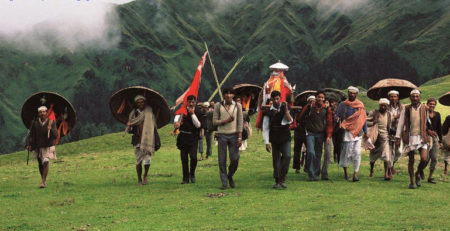
Traditionally, men wore Ranga, Kameez, Pajama, and Jyujung, a turban known as Baintlo was also worn by men. Bhotiya men never wore any kind of jewelry except gold rings these days married men of this generation wore gold chains and rings.
And women traditionally wore garments like Chung, Rankalch Bala and Jyujung women traditionally wore headdresses known as Chyukti along with Bhabhche, women were fond of various ornaments known as Sale Pule, and various neck Ornaments such as Baldang Chandrahar, Kanthi, Kakshalain, and Sutta. Kakshalain is a symbol of Suhagan (Married Women).
Trade
The Bhotiya people are also known for their traditional attire, which includes woolen garments and intricate jewelry, often crafted by the women of the tribe. They practice farming and animal husbandry, relying on their livestock for milk, meat, wool, and trade. Many Bhotiya families also engage in the making of traditional handicrafts, such as carpets and woolen textiles, which are highly valued for their quality. Trade has been the mainstay of the Bhotia economy their trade relationship with Nepal exported ingredients were grain, Sugar, Gur, Spices, Tobacco, Cotton, etc., and items imported were Salt, Wool. They have many foods and spices which are Thawe, a herb that grows wild. It has many health benefits, Jholi with rice, Kwacho which grows in the land of Bhotia used in dal and fried vegetables, katki to cure fever, ina to cure cough and wild Goat also called Phasi is a popular dish of the community when they are in higher settlements. Sometimes they prepare Phasi for religious rituals.
Social Status
In 2001, the Uttarakhandi Bhotiyas were classified as a Scheduled tribe under the Indian Government Reservation program of positive discrimination.
As of 2011, there were a total of 39,106 Bhotia in Uttarakhand.
The Bhotiya speak a range of languages under the broader Tibeto-Burman family, collectively referred to as “Bhoti” or “Bhotia,” and they often use the Tibetan script in writing. These people, also known for their pastoral lifestyle, were once involved in cross-border trade between India and Tibet, a tradition that has shaped their way of life for centuries. The Bhotiya tribe’s ancient trade routes, particularly the famous Salt and Wool trade, played a significant role in shaping the region’s economy and culture.
A distinct feature of the Bhotiya tribe is their deep bond with the Bhotiya dog, a robust, working dog breed traditionally used by the tribe for guarding livestock, herding, and protecting their homes in the rugged Himalayan terrain. The Bhotiya dog is known for its loyalty, strength, and courage, making it an essential companion for the tribe in the harsh mountainous conditions. These dogs are prized for their ability to survive in extreme weather and navigate the treacherous terrain, often acting as protectors of the tribe’s herds of sheep, goats, and yaks. The Bhotiya dog also plays a role in protecting the tribe’s homes from wild predators such as leopards and wolves.
Resilient in the face of challenges like isolation and economic shifts, the Bhotiya community continues to preserve its identity through vibrant customs, distinct art forms, and an unbroken bond with the land they call home. Today, they are recognized as a Scheduled Tribe in India, receiving legal protections and privileges to help maintain their cultural and social rights. Despite modern pressures, the Bhotiya people have worked hard to protect their unique way of life, ensuring that the traditions of their ancestors continue to thrive.
The Bhotiya tribe stands as a testament to the enduring spirit of the Himalayan people and their ancient ways of living harmoniously with nature. Their deep-rooted connection to the land, the animals they care for, and their community values ensure that they will remain an integral part of the rich cultural mosaic of the Indian Himalayas for generations to come.
FAQs About the Bhotia Tribe
- Who are the Bhotia people?
The Bhotia, also known as Bhotiya, are an ethno-linguistic group primarily inhabiting the upper Himalayan valleys of Uttarakhand, Himachal Pradesh, Sikkim, Arunachal Pradesh, and parts of Nepal and Tibet. They are presumed to have Tibetan heritage. - What language do the Bhotia people speak?
The Bhotia people speak various Tibeto-Burman languages, collectively known as Bhoti or Bhotia. These languages are written in the Tibetan script and are spoken in regions of India, Nepal, Tibet, and Bhutan. - What is the origin of the word “Bhotia”?
The term “Bhotia” comes from the classical Tibetan name for Tibet, “bod” (བོད), which means “Tibetan.” It is used to refer to various groups in the Trans-Himalayan region. - Are the Bhotia people related to other ethnic groups?
Yes, the Bhotia are closely related to other groups in the region, such as the Bhutia people of Sikkim, the Shauka tribe of Kumaon, and the Dzongkha-speaking Ngalop of Bhutan. They are also related to Tibetans, Sherpas, and several groups in Nepal. - What are the sub-groups of the Bhotia tribe?
The Bhotia tribe has several sub-groups, including the Bhutia of Sikkim, the Shauka tribe of Kumaon, the Gyagar Khampa of Khimling, the Bhidang of Uttarakhand, and the Tibbati people of Sikkim and Arunachal Pradesh. - Where are the Bhotia people found in India?
The Bhotia people are found in various states of India, including Uttarakhand, Himachal Pradesh, Jammu and Kashmir, Sikkim, Arunachal Pradesh, Uttar Pradesh, West Bengal, Assam, and Tripura. - Do the Bhotia people have Scheduled Tribe status?
Yes, the Bhotia people have been granted Scheduled Tribe status in several Indian states, including Uttarakhand, Himachal Pradesh, and Uttar Pradesh, among others. - How many Bhotia people live in Nepal?
In Nepal, the Bhotia people represent about 0.1% of the population, primarily living in the northern and eastern Himalayan regions. According to the 2001 census, there were around 27,230 Bhotia people in Nepal. - What are the major challenges faced by the Bhotia tribe?
The Bhotia people face challenges such as limited access to modern amenities, economic hardships due to the loss of traditional trade routes, and the preservation of their unique culture and language amidst modernization. - Is the Bhoti language officially recognized in India?
The Bhoti language, though widely spoken among the Bhotia people, is not yet included as an official language in India under the Eighth Schedule of the Indian Constitution.