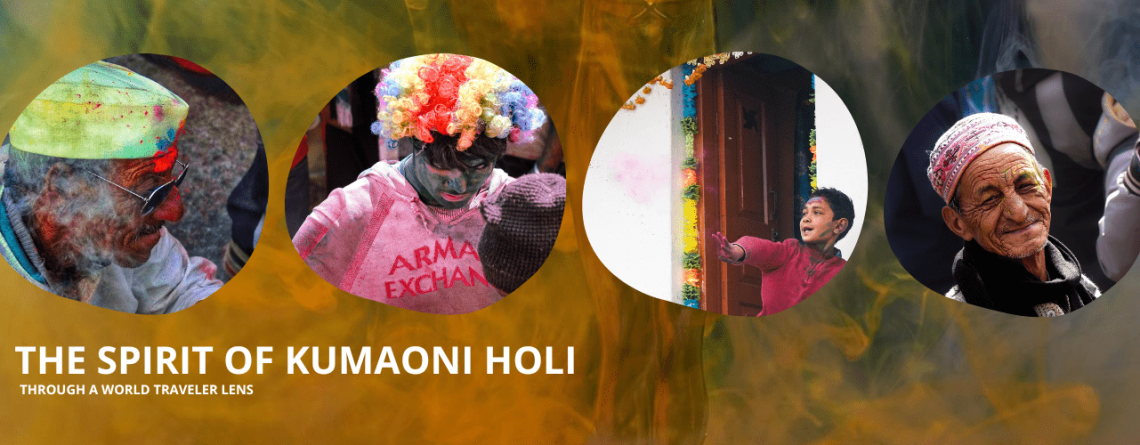
The Spirit of Kumaoni Holi
Through a World Traveler Lens
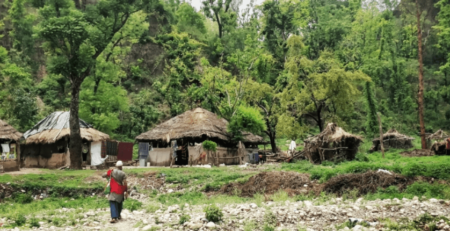
Some journeys are planned, others are gifted by fate – this was the latter. What began as a quiet workation in the Kumaon hills transformed into one of the most soulful experiences of my travels. I hadn’t planned to witness Holi, much less become part of a living tradition that spans centuries. But Kumaoni Holi isn’t something you observe from a distance – it pulls you in, colors your senses, and leaves you forever changed. Unlike the loud, fast-paced Holi I knew in the cities, this one unfolded like a story – slowly, musically, soulfully. It was less about colors and more about connection. In these hills, Holi arrives not with noise, but with melody – in the form of classical ragas, circular gatherings under trees, and heartfelt songs passed down through generations.
I was a stranger with a camera, yet was welcomed into homes as if I belonged. This was not just a festival – it was a community’s heartbeat. In the rhythm of dholaks, in shared cups of tea, and in the unspoken invitation to sing along, I found more than celebration. I found presence, legacy, and a quiet kind of joy that lingers long after the colors fade.
Some stories stay with you long after you’ve packed your camera. This is one of them.
An Unexpected Invitation
It started unexpectedly. I was on a workation in the hills, hoping for some peace, unaware that I had landed right in the middle of something extraordinary – Kumaoni Holi. For four days, I kept hearing drums echoing through the valleys – a sound that tugged at my curiosity. I asked Bablu, the local chef at my Airbnb, what was going on. He smiled and said, “Holi yahan ek din ki nahi hoti, bhaiya. Hafte bhar chhayi rehti hai.” I had no idea Holi here lasted for over a week. That day, Bablu didn’t just answer my question – he invited me in.
A Festival That Visits Every Door
In Kumaon, Holi doesn’t burst in all at once. It arrives in waves – starting with Baithaki Holi, where people gather indoors to sing classical ragas. Then comes Khari Holi, where the whole village becomes the celebration. What I witnessed over the next few days was nothing like the Holi I knew. There were no wild crowds or loudspeakers. Instead, there was togetherness and movement – slow, musical, intentional.
The villagers moved from house to house in groups, singing, dancing, playing with colors. Not a single home was left out. That mattered. It wasn’t just about celebration – it was about assurance. About telling every family, “You are part of us.” At every doorstep, the hosts offered whatever they could – tea, snacks, meals. There was no show, no competition. Just warmth. Just presence.
The Drumbeat of Belonging
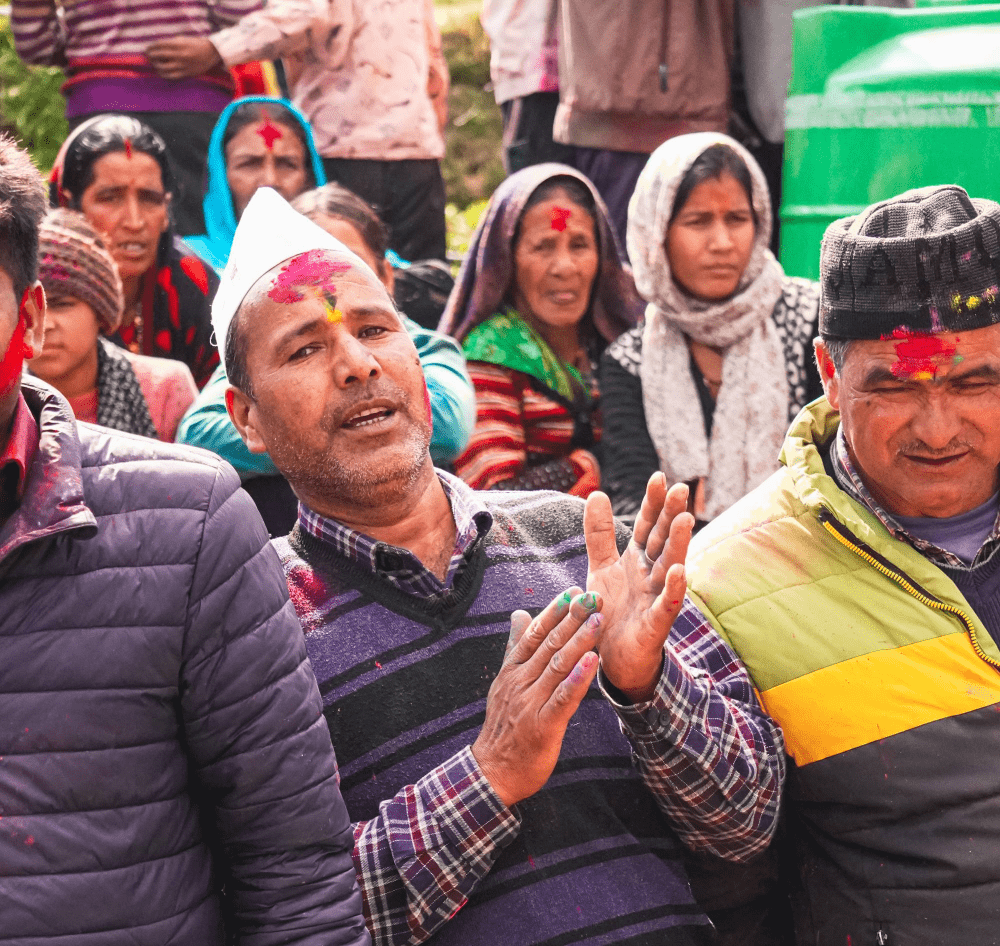
The music was hypnotic. And not just because of the instruments – though the dholak and manjira echoed beautifully through the hills – but because of the way it was carried. There was depth in every note, and history in every word. Many of the elders had been singing these songs their entire lives. You could tell by the way they didn’t think before joining in – it was in their bones. The younger ones followed, learning by doing, learning by being present.
I spoke to one elderly man in his nineties. He told me, smiling, “Pehle ke gaane bhi yaad hain, aur ab toh pote-potion ke saath gaata hoon.” He had sung these songs with his father. Now, he sings them with his great-grandchildren.
That’s when I understood – this wasn’t a performance. It was a legacy being passed, voice by voice.
The Legacy of Khadi Holi
I learned this form of celebration is called Khadi Holi – a tradition unique to the Kumaon region. It begins on Falgun Ekadashi and stretches all the way to Chaldi, the final farewell to Holi. Each day, groups of Holiyaars – traditional Holi singers – walk through the village singing songs that have lived in these mountains for centuries. The instruments are simple: dhol, hurka, manjira. But the effect is profound. During the day, villagers sing together in circular gatherings – under trees, in courtyards, or near temples. As the sun dips, the mood shifts into Baithaki Holi, where people sit close, sing softer, and let the music move inward. The hospitality is just as much a part of the tradition as the music.
Villagers welcome the Holiyaars with whatever they have – tea, sweets, food or even just folded hands and a smile. No one is excluded. No offering is too small. Some locals told me about an old tradition called Cheer Bandhan, where villages would playfully steal ceremonial cloths from one another, setting up friendly musical “battles” the next year. Though that practice has faded, the playfulness and togetherness remain deeply intact. In Kumaon, Holi is a social thread – tying homes, generations, and memories together.
Faces That Stayed With Me
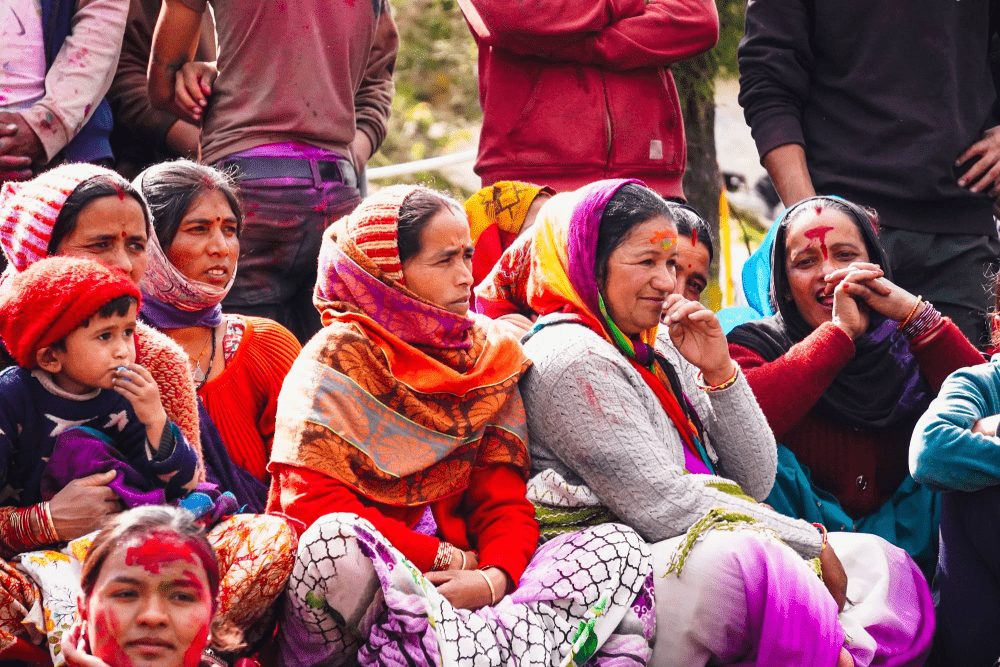
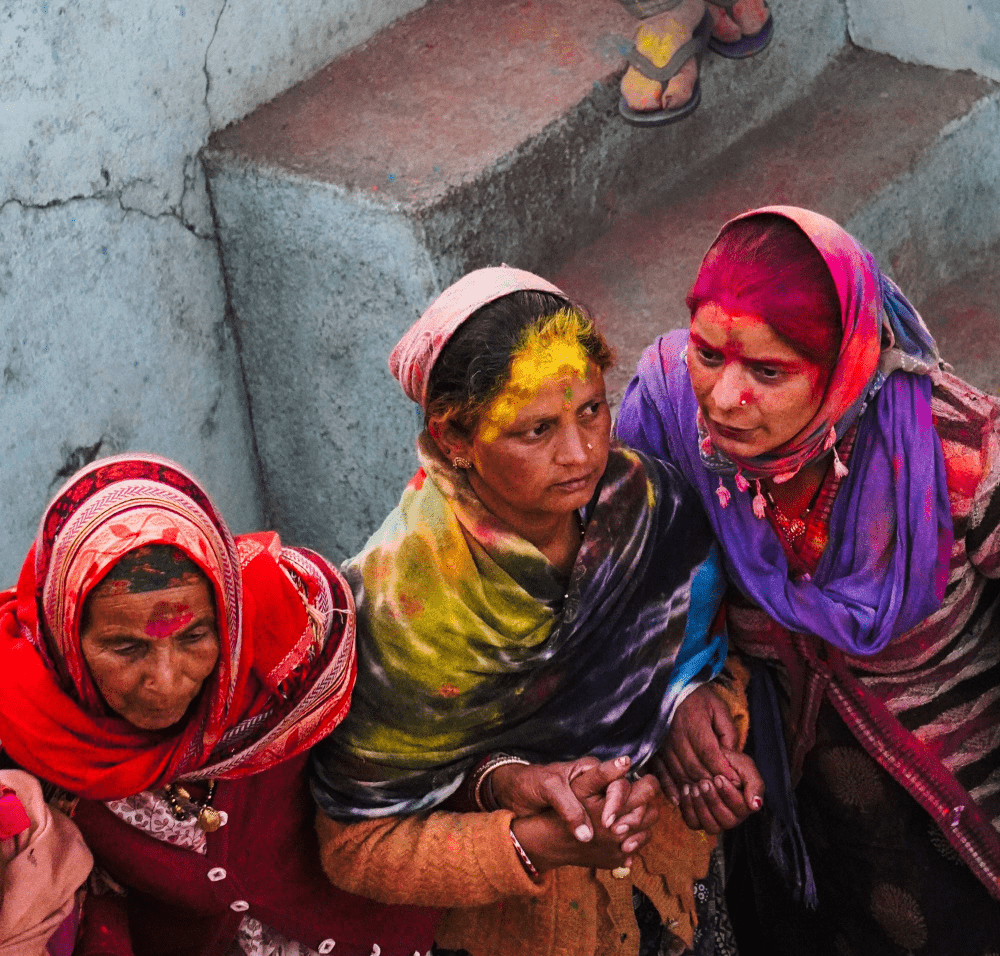
Through my lens, I captured smiles that weren’t posed and colors that weren’t thrown for drama. The women were initially shy – unsure about the camera – but many of them opened up with excitement. I remember one who smiled and said, “Yeh photo kahaan aayega?” I showed her my Instagram. She nodded, smiled, and joined the next song. The men were the opposite – full of curiosity and stories. Many of them were amazed I’d come from Delhi to see their Holi. “Hamare yahaan toh koi photo kheenchne nahi aata,” one of them said with a grin. “Lag raha hai jaise do alag desh mil rahe hain.” It did feel like that sometimes – like two different worlds were speaking.
The children followed me from house to house, sometimes more interested in my camera than the celebrations. Every home I entered treated me like one of their own. I wasn’t just allowed to photograph them – I was invited to sit, eat, dance, and even sing. What I Took With Me I arrived in Sunderkhal with a camera and curiosity. I left with something much harder to name – a sense of belonging to something older, wiser, and deeply rooted. As a photographer, I’ve always believed in the importance of noticing the unnoticed. But here, I learned that sometimes, you don’t need to capture a moment – you just need to be in it. If these photos and words carry even a fraction of what I felt – the stillness, the music, the shared breath of a community in celebration – then perhaps you’ll feel it too. The Holi I saw didn’t ask for attention. And yet, it echoed through me louder than any celebration ever has.
As I packed my bags and looked back at the winding roads of Sunderkhal, I realized I wasn’t leaving with just photographs or memories – I was carrying a piece of Kumaon with me. The rhythms of the dholak still echoed in my ears, the warmth of strangers-now-friends lingered in my heart, and the gentle strength of a tradition so deeply rooted stayed etched in my soul. Kumaoni Holi is not a spectacle, it’s a feeling – quiet yet powerful, festive yet reflective. It doesn’t demand attention but quietly transforms those who are willing to pause and listen. It reminded me that the truest colors of celebration aren’t always the brightest – sometimes, they are the soft hues of community, legacy, and shared humanity. In a world rushing forward, Kumaon taught me the grace of moving slowly – of celebrating not with noise but with meaning. And in doing so, it gave me the rarest gift a traveler can receive: not just a story to tell, but a place to return to – in memory, in spirit, and perhaps, one day, once again in person.