Khatarua
Khatarua is a special festival of the agricultural society celebrated in mid-September in Uttarakhand. It is mostly observed by villagers in the tiny hamlets of the state and marks the beginning of autumn. Khatarua is one of the prime festivals in Uttarakhand, celebrated with fervor and zeal. On this day, people light bonfires around which children dance, holding aloft colorful flags. The festival occurs on the first day of the month of Ashwin according to the Hindu calendar, creating an atmosphere of joy and warmth in the mountain villages of Kumaon.
The festivities begin with preparations, during which villagers engage in cleaning the animal shelters to ensure a healthy environment for their livestock. This activity reflects the reverence the community holds for their animals, essential for their livelihood. After cleaning, the animals are bathed, symbolizing purity and care.
A significant ritual during Khatarua involves preparing a special bonfire, which is carried around the animal shelters. This fire is believed to ward off evil spirits, with its flames serving as a symbol of protection. Children play a vital role in the celebration; they sing traditional folk songs like “Bhaillau Ji Bhaillau” and “Gai Ki Jeet, Khatarua Ki Haar,” while effigies adorned with flowers are burned. This vibrant scene not only entertains but also strengthens the community’s cultural heritage.
A unique aspect of the festival is the application of the ashes from the burned effigies on the foreheads of the animals, serving as a blessing for their good health. After the festivities, local fruits like ‘Kakad‘ or cucumber are distributed as prasad, symbolizing prosperity and gratitude for the harvest.
Khatarua is not merely a celebration of the agricultural cycle; it is also a time for families and communities to come together, strengthening social ties. The shared experiences of rituals, music, and feasting foster a sense of unity, reflecting the values of cooperation and support among villagers.
Legends of Khatarua
There is an age-old legend associated with Khatarua that celebrates the victory of an ancient King of the Chand dynasty in Kumaon against Garhwal. This was during a time when, after two years of fierce battles among the heirs of King Rudra Chand, King Baz Bahadur Chand ascended the throne of Kumaon. Taking advantage of the prevailing chaos, the King of Garhwal invaded the region, attacking and killing Kumaonis. The hapless villagers pleaded with Bahadur Chand for protection. He dispatched a battalion of some of his bravest men to the fort of Chandpur Garhi, near Abidari. However, being situated on top of a hill, the Garhwal army had the upper hand, killing Bahadur’s soldiers as they climbed up. Tactfully, the King devised a clever plan—he sent a horde of cows with his soldiers, who waved flags adorned with pictures of cows as they stormed into Garhi. Since cows are sacred to the Garhwal population as well, Khatar Singh and his men hesitated to launch an effective offensive, fearing for the cows’ safety. Thus, the King of Kumaon defeated the aggressive Garhwal army.
This relates to the importance of cows in celebrating Khatarua. In the scarcity of other food in the war-torn region, the victorious Kumaoni soldiers celebrated by sharing cucumbers. The bonfires served as communication symbols to convey the message of victory to Kumaon’s capital, Almora.
Celebration of Khatarua
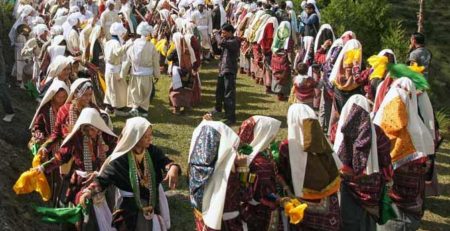
Some believe that this festival commemorates the victory of the King of the Kumaon Region. It also marks the onset of the autumn season. On the day of the celebration, villagers gather to rejoice in the new harvest. Large quantities of firewood and grass are stacked at prominent places, and a dummy of Khatarua is erected. As darkness falls, these heaps are set ablaze, referred to as the ‘fire of Khatarua.’ Large groups of jubilant people gather around the fire, and children hold colorful flags. Cucumbers are offered to the fire, believed to destroy all evils and negativity, bringing joy and prosperity, thereby establishing goodness on earth. During this festival, animals are given special care and fed with fresh grass. The entire atmosphere is filled with happiness and merriment.
After sunset, each family prepares torches to brandish over cattle sheds, the entrances of their homes, and young children. These torches are then carried to ignite the effigies in community bonfires.
Once the bonfire is lit and the celebration is in full swing, small children sing and dance around the fire, joining in the festivities. People uphold flags to celebrate the arrival of the autumn season, creating a beautiful environment where everyone enjoys and has a lovely time.
Despite recent moderation in some parts of the region due to the provocative underpinnings of the Garhwal-Kumaon battle tale, the special festival of Khatarua continues to fascinate the innocent mountain people as they hop around singing, “Chal Khatarua dhaare dhaar; gau ki jeet, khature ke haar,” which translates to “Let Khatarua (animal disease) travel from one hilltop to another; the cow has won and Khatarua has lost.
Although primarily celebrated in Kumaon, the significance of Khatarua extends to parts of Garhwal and even Nepal, where similar traditions are observed. This festival exemplifies the rich cultural tapestry of Uttarakhand, where tradition and communal spirit unite to celebrate natural cycles.
In conclusion, Khatarua is more than just a local event; it is an essential expression of Kumaoni identity, celebrating health, change, and the strong bonds within the community. As it thrives amidst modernity, Khatarua remains a symbol of the strength of tradition and the collective spirit of the people of Uttarakhand.