Uttarakhand Holi
A Unique Blend of Tradition and Melody
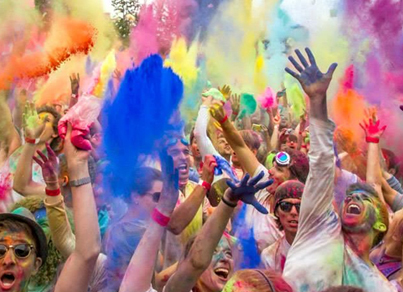
Holi is one of the most loved festivals of India when people forget all the enmities and resentments and come together to spread colour in each other’s lives. The festival comes during Phalgun Purnima and it usually is celebrated in the end of February or in the beginning of March. This festival has its roots in ancient times which signify the triumph of good over bad. It’s a way of revivifying our relationship and bridging the gap between the different sections of the society. People all over India including Uttarakhand, on the day of Holi, wish each other by hugging each other and hurling various colours. Holi comes with an enthusiasm of saying good bye to the winter season and welcoming spring.
Holi is celebrated with the same passion and gaiety in the state of Uttarakhand same as in other states of the country. The state is an amalgamation of various cultures from different parts of the country. It is believed to be one of the best and most attractive places in the country which gets lightened up and colourful for having been inhabited by plethora of tribes. It’s an unbelievable site during most of the cultural holidays and Holi is not an exception to it. The uniqueness lies in the fact that the celebration is done with three different forms. Here’s how people of Uttarakhand celebrate Holi and the three forms Kumaoni Holi that it takes:
Baithki Holi
Baithki Holi (Sitting Holi) is a form of musical gathering starting from the day of Basant Panchmi held all across Kumaon till the Dulhendi (or the last full moon day of the lunar month Phalguna). The Baithaki Holi songs are based on Classical Music with heavy influence of Kumaoni folk music traditions.
The Baithki Holi begins from the premises of temples, where Holiyars (the singers of Holi songs) and other people gather to sing songs with musical instruments like harmonium and tabla. The Baithaks or sittings are held in the local community centres and even at local homes.
Khadi Holi
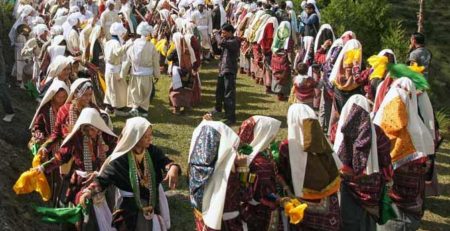
Khadi Holi (Standing Holi) starts a little later than Baithaki Holi. The songs of the Khari Holi are sung by the people, sporting traditional white nokdaar topi, churidar payjama and kurta, dance in groups to the tune of ethnic musical instruments like the Dhol and Hurka.
Kumaoni people (especially from the rural parts of Kumaon) sing folk songs adorned in the traditional attires, which consist of white nokdaar topi, churidar pyjama along with kurta. The air is filled with vibrant music, and one can witness the Kumaoni people visiting houses of their loved ones and singing their folk songs, dancing in groups on their music which incorporates ethnic instruments like the Dhol and the Hurka. It is primarily celebrated by men, and the groups of men (known as ‘tolis’) keep the atmosphere enthusiastic and lively. Commonly sung songs are- ‘jhankaro-jhankaro jhankaro‘ and ‘jogi aayo sheher mein vyaapari‘.
Mahila Holi
This form of Holi is quite similar to the Baithki form, except the fact that here the gatherings are entirely composed of the women. Songs based on love and spiritual unions are sung by the native women of the region. The example of a commonly sung song during Mahila Holi is- ‘Balma ghar aayo phagun mein‘.
Cheer Bandhan and Cheer Dahan in Kumaon and Garhwal
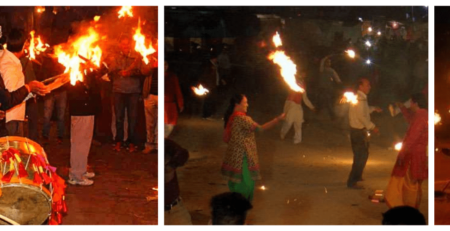
In both Kumaon and Garhwal, the Holika bonfire is known as Cheer, and its preparation is a significant part of the Holi festivities. The ritual of creating the bonfire is called Cheer Bandhan, which takes place fifteen days before Dulhendi. During this ceremony, a bonfire is made, with a green Paiya tree branch at the center. This tradition is practiced in villages and neighborhoods, and it involves a playful competition, as each community rigorously guards its Cheer while rival neighborhoods try to steal it. The Cheer Dahan, or the burning of the Cheer, happens the night before Holi and symbolizes the victory of Prahlad over the evil plans of his father, echoing the theme of good triumphing over evil.
Chharadi (Dulhendi)
In both regions, Dulhendi is known as Chharadi, a term derived from Chharad, which means natural colors made from flower extracts, ash, and water. People celebrate by applying Abeer and Gulal in vibrant colors. Another significant tradition is the use of Tesu flowers to prepare colored water. The flowers are gathered, dried in the sun, ground into powder, and mixed with water to create a natural orange-yellow color. This celebration with colors marks the joyous spirit of Holi in Kumaon and Garhwal.
Shubh Kamna
The joyous atmosphere of Holi in Kumaon and Garhwal is also marked by the tradition of Shubh Kamna. People come together to play Holi and pray for prosperity, well-being, and happiness for their loved ones. They chant mantras like ‘ho ho ho lakh re’, while throwing Gulal in the air, wishing for the well-being of elders and their communities. This practice is a beautiful expression of unity and good wishes, reflecting the cultural richness of both Kumaon and Garhwal during Holi.
The integration of natural elements like Tesu flowers, traditional bonfires, and communal prayers makes Holi in Kumaon and Garhwal a unique blend of cultural heritage and festive joy.