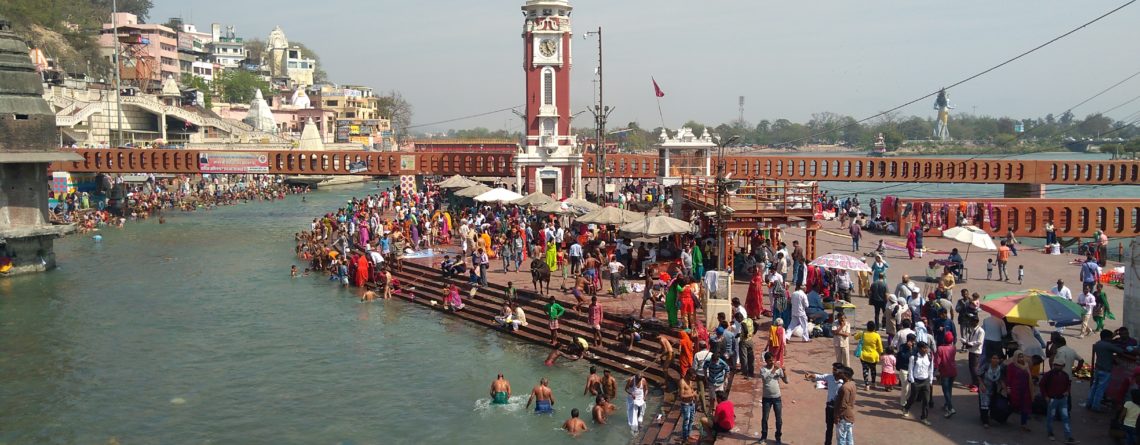
Har ki Pauri
Haridwar is one of the most ancient pilgrimage centers in India that has been reverence from times immemorial. Hari means (Lord/God) and Dwar means Gateway. Hence Haridwar means Gateway to the Lord. According to Indian mythology, it is one of the four places where drops of elixir, Amrita accidentally spilled over from the pitcher or Kumbha, in which it was being carried away by the celestial bird Garuda, the vehicle of Lord Vishnu. These four spots have today become places where the Kumbh Mela is celebrated every 12 years in succession – Nasik, Ujjain, Haridwar, and Allahabad. Millions of devotees and tourists congregate from all over the world to celebrate this celestial event and perform ritualistic bathing on the banks of the river Ganges.
Har Ki Pauri is a famous ghat on the banks of the Ganges in Haridwar in Uttarakhand state in India. This revered place is the major landmark of the holy city of Haridwar. Literally, “Har” means “Lord Shiva” who is the god according to the Shaivite school of Hindu theology, “ki” means “of” and “Pauri” means “steps”. Lord Shiva and Lord Vishnu are believed to have visited the Brahmakund in Har ki Paudi in the Vedic (ancient period) times. There is a large footprint said to belong to Lord Vishnu on a stone wall.
Har ki Pauri Story
Har Ki Pauri is closely associated with the legendary story of the churning of the ocean, or “Samudra Manthan.” This tale is central to the temple’s history.
During the time of the churning, the gods lived on Earth with the purpose of creating and expanding life. Both gods and demons, known as asuras, were present on Earth. To achieve their goal, the supreme deities Brahma, Vishnu, and Shiva devised a plan involving the churning of the ocean to obtain the nectar of immortality, or “amrita.”
The churning of the ocean yielded 14 precious gems, among which the 14th and most coveted was the nectar of immortality. This nectar, when consumed, would grant eternal life to anyone who drank it.
The nectar was stored in a kumbh (pot). During the struggle for this nectar, a fierce battle ensued between the gods and the demons, lasting approximately 12 days. It is believed that during this struggle, a few drops of the nectar fell to Earth at four sacred locations: Haridwar, Prayag, Ujjain, and Nashik.
The drops of nectar that fell at Har Ki Pauri contributed to its significance and sanctity. This is why Har Ki Pauri is also referred to as Brahmakund. The association with the nectar of immortality has led to the temple being considered a gateway to liberation or moksha. The concept of “charanamrit” (foot nectar) and “panchamrit” (five nectars) also originates from this legend, enhancing the spiritual importance of Har Ki Pauri.
Har Ki Pauri is believed to be the exit point of the Ganges from the mountains and entry into the plains. An area within Hari ki Pauri, where the evening Ganga Aarti takes places and which is considered most sacred is known as Brahm Kund, The spot where the nectar (Amrita) fell is today considered to be Brahma Kund at Har-Ki-Pauri (literally means footsteps of the Lord) which is the most sacred ghat in the Haridwar. Thousands of devotees and pilgrims flock here from all over the world to take a holy dip; it is believed that a dip here will wash away their sins or Karma and provide Moksha. The ghat is on the west bank of the Ganges canal through which the Ganges is diverted just to the north. Har ki Pauri is also the area where thousands of pilgrims converge and the festivities commence during the Kumbha Mela, which takes place every twelve years, and the Ardh Kumbh Mela, which takes place every six years and the Punjabi festival of Vaisakhi, a harvest festival occurring every year in the month of April.
King Vikramaditya constructed this sacred ghat in memory of his brother Bhatrihari who it is believed had come to Haridwar to meditate on the banks of the Ganga. This ghat later came to be known as Har-Ki-Pauri (also called Brahamakund). At twilight, golden hues of floral diyas reflected in the river Ganga present the most enchanting sight. The imprint of Lord Hari’s footprint hallows the riverbank temple here. The ghat is regarded as the most sacred and auspicious point to bathe in the Ganga during the Kumbh held after 12 years and Ardh Kumbh after 6 years.
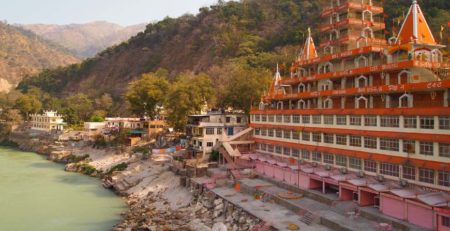
The place is considered very auspicious. Over the years the ghats have undergone major extension and renovation as the crowds increased in subsequent Kumbh Melas. Several temples have come up on the steps, most built in late 19th century. The extension of the ghats took place in 1938 (done by pandit Hargyaan Singh Katara -Zamindaar from Agra in Uttar Pradesh), and then again in 1986. Every day, Hari Ki Pauri ghat witnesses hundreds taking a dip in the water of the Ganges. Each evening at sunset priests performs Ganga Arti here when lights are set on the water to drift downstream. This is the most amazing and soul-touching spectacle. A large number of people gather on both the banks of river Ganges to sing its praises. The priest holds large fire bowls in their hands, the gongs in the temples at the Ghat start ringing and the chants flowing out of lips fill the air. People float earthen diyas, with burning flickers and flowers in them as a symbol of hope and wishes. The golden hues of floral diyas reflected in the river Ganges present the most enchanting sight.
FAQs
What makes Har Ki Pauri one of the holiest sites in India?
Har Ki Pauri is considered one of the most sacred ghats in India because it is believed to be the very spot where nectar (amrit) from the Samudra Manthan fell, making it a site of divine significance. It is also where Lord Vishnu is said to have left his footprint on a stone, making it an important pilgrimage center for Hindus seeking salvation.
What happens during the Ganga Aarti at Har Ki Pauri?
The Ganga Aarti at Har Ki Pauri is a grand spiritual ceremony conducted every morning and evening, where priests hold large, multi-tiered brass lamps filled with ghee, wave them in rhythmic patterns, and chant Vedic hymns. The riverbank glows with thousands of floating diyas (oil lamps), creating a mesmerizing sight. Devotees participate by offering prayers, lighting diyas, and taking a holy dip in the Ganga.
Why do people take a holy dip in the Ganga at Har Ki Pauri?
According to Hindu beliefs, a holy dip in the Ganga at Har Ki Pauri washes away sins and grants moksha (liberation from the cycle of birth and death). The Brahmakund area, located at Har Ki Pauri, is considered the most auspicious place for taking a ritual bath, especially during special occasions like Kumbh Mela and Kartik Purnima.
What is the history behind the construction of Har Ki Pauri?
Har Ki Pauri was constructed in the 1st century by King Vikramaditya in memory of his brother Bhartari, who was a great devotee of Lord Shiva. Over centuries, various rulers and saints have contributed to its expansion and maintenance, making it the spiritual heart of Haridwar.
How does Har Ki Pauri relate to the Kumbh Mela?
Har Ki Pauri is one of the four primary sites where the Kumbh Mela, the world’s largest religious gathering, is held every 12 years. During this time, millions of devotees and ascetics from across India and the world take a holy dip in the Ganga, believing it to be a once-in-a-lifetime opportunity for spiritual purification.
Are there any special days or festivals celebrated at Har Ki Pauri?
Yes, several Hindu festivals and special occasions are celebrated at Har Ki Pauri, including:
- Kumbh Mela (every 12 years) – The largest religious congregation in the world.
- Ardh Kumbh Mela (every 6 years) – A smaller version of the Kumbh Mela.
- Ganga Dussehra – Celebrates the descent of the Ganga to Earth.
- Kartik Purnima – A full-moon festival that attracts thousands of devotees.
- Makar Sankranti – Considered highly auspicious for a holy dip.
What are some of the spiritual and historical legends associated with Har Ki Pauri?
Har Ki Pauri is deeply connected to Hindu mythology. It is believed that Lord Brahma performed yagna (sacrificial fire rituals) here. Another legend states that Lord Shiva and Lord Vishnu visited this place, leaving their divine imprints. Additionally, Haridwar is mentioned in ancient texts like the Mahabharata and Puranas, highlighting its religious importance.
What is the best way to reach Har Ki Pauri?
Har Ki Pauri is well connected by road, rail, and air:
- By Air: The nearest airport is Jolly Grant Airport, Dehradun, about 35 km from Haridwar.
- By Train: Haridwar Railway Station is just 2 km from Har Ki Pauri and is well connected to major cities in India.
- By Road: Haridwar is accessible via NH-58 and is well connected to Delhi, Rishikesh, and other cities by buses and taxis.
Is there a specific dress code for visiting Har Ki Pauri?
There is no strict dress code, but it is advisable to wear modest, traditional attire while visiting Har Ki Pauri. If taking a dip in the river, visitors should wear appropriate clothing like a dhoti, saree, or a simple salwar-kameez.
Are there any restrictions for tourists visiting Har Ki Pauri?
Har Ki Pauri is open to all tourists and pilgrims, but visitors should be mindful of the following:
- Avoid stepping into deep water as the Ganga has strong currents.
- Do not litter or pollute the river, as it is considered sacred.
- Respect the sanctity of the place by maintaining silence during rituals.
- Be cautious of pickpockets, especially during crowded festivals.
Is there any accommodation available near Har Ki Pauri?
Yes, Haridwar has a wide range of accommodations, from budget guesthouses and dharamshalas to luxury hotels. Many ashrams also provide free or low-cost lodging for pilgrims.
What are some nearby religious and tourist attractions to visit along with Har Ki Pauri?
Visitors can explore several nearby attractions:
- Mansa Devi Temple – Accessible by ropeway, offering a panoramic view of Haridwar.
- Chandi Devi Temple – Another important Shakti Peeth temple.
- Maya Devi Temple – One of the 51 Shakti Peethas of Hindu mythology.
- Bharat Mata Mandir – A temple dedicated to Mother India.
- Daksheshwar Mahadev Temple – An ancient Shiva temple associated with King Daksha.
- Rajaji National Park – A great place for wildlife and nature lovers.
How does the Geographical Importance of Har Ki Pauri contribute to its significance?
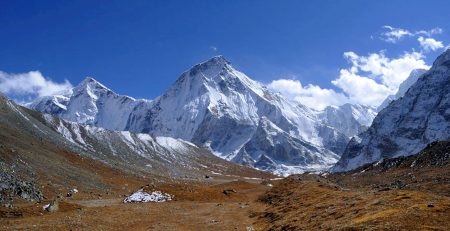
Har Ki Pauri is situated at the foothills of the Himalayas, where the Ganga enters the plains for the first time, making it a significant spiritual and geographical landmark. The location enhances its purity and religious importance.
How safe is Har Ki Pauri for solo travelers, families, and international tourists?
Har Ki Pauri is one of the safest pilgrimage sites in India, with heavy police presence and security measures in place, especially during festivals. Families, solo travelers, and international tourists can visit safely, but it is advisable to stay cautious about belongings and avoid isolated areas at night.
What is the environmental importance of Har Ki Pauri and the Ganga River?
The Ganga is not just a spiritual river but also a lifeline for millions, providing water for drinking, agriculture, and daily activities. Several Ganga conservation projects are in place, such as the Namami Gange Programme, to reduce pollution and protect the river’s ecosystem.
How is Har Ki Pauri different from other ghats in India?
While many cities have ghats, Har Ki Pauri stands out due to its mythological significance, the presence of Vishnu’s footprint, the daily Ganga Aarti, and its role in the Kumbh Mela. Unlike Varanasi’s ghats, which are known for cremations, Har Ki Pauri is primarily for prayer and ritual baths.
Can foreigners visit Har Ki Pauri, and are there any special rules for them?
Yes, foreigners are welcome at Har Ki Pauri. There are no special rules, but they should respect local customs, dress modestly, and participate in rituals with an open mind. Many international tourists visit Haridwar for yoga and spiritual retreats.
How has Har Ki Pauri evolved over the years?
Over the centuries, Har Ki Pauri has transformed from a simple ghat built by King Vikramaditya to a grand religious complex visited by millions. Modern developments include better infrastructure, riverbank protection, and tourism facilities, while still maintaining its spiritual essence.
Har Ki Pauri in Haridwar is not just a ghat; it is a symbol of faith, spirituality, and divine purity. With its deep-rooted mythological significance, sacred rituals, and breathtaking Ganga Aarti, it continues to be a beacon of devotion for millions of pilgrims and visitors from around the world. Whether you are seeking spiritual enlightenment, cultural experiences, or a serene escape, Har Ki Pauri offers a profound connection to India’s rich religious heritage. A visit to this holy site, combined with a holy dip in the Ganga, is believed to cleanse the soul and bring blessings.
As Har Ki Pauri stands at the confluence of faith, history, and natural beauty, it remains an eternal destination that embodies the essence of Haridwar – the Gateway to the Gods.