Gopal Babu Goswami
Soul of Uttarakhand’s Music Industry
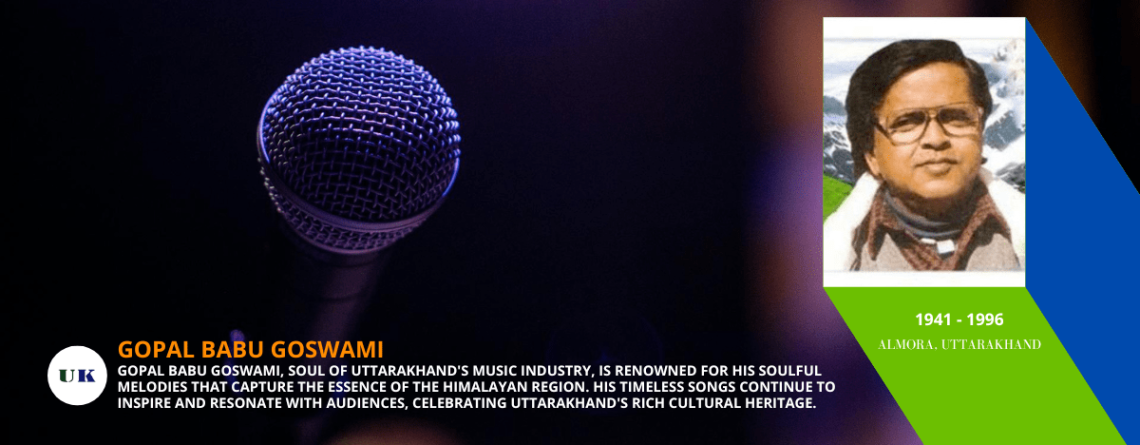
Gopal Babu Goswami (1941–1996), a legendary figure in Uttarakhand’s folk culture and traditions, devoted his life to elevating Kumaoni folk music to new heights. His name has become synonymous with the rich heritage of Kumaoni music. Through his melodious voice, folk ballads, and simple approach to life, he not only won the hearts of the people of Uttarakhand but also gave a distinct identity to its culture across the nation.
Early Life and Education
Gopal Babu Goswami was born on February 2, 1941, in Chandikhet village, Chaukhutiya Tehsil, Almora District (then in the United Provinces, now Uttarakhand). He belonged to a humble farming family, with his father Mohan Giri and mother Chanuli Devi.
Gopal Babu received his early education at a government school in Chaukhutiya. However, the untimely death of his father during his eighth grade forced him to abandon his studies due to financial difficulties.
Like many young men from the hills, he went to Delhi in search of work. He tried his hand at various odd jobs in Delhi, Punjab, and Himachal but failed to find a stable livelihood. Eventually, he returned to his village and took up farming.
The Beginning of a Musical Journey
Music was an integral part of Gopal Babu’s life from childhood. Although he never received formal training, his soul was steeped in music.
In the 1970s, a troupe from the Uttar Pradesh Song and Drama Division visited Chaukhutiya for a performance. During this visit, he met officials from the division who recognized his talent and advised him to connect with their office in Nainital.
In 1971, Gopal Babu was appointed as a singer in the division. This marked the turning point in his musical journey.
- He auditioned at Lucknow All India Radio (AIR) and became a registered artist.
- His first song, “Kailai Bajai Muruli O Baina” was broadcast on AIR and made him popular among Kumaoni music lovers.
Soaring Popularity
In 1976, H.M.V. released his first music album. After this, many of his songs became hits, and his music found a place in every household in Uttarakhand. Some of his iconic songs include:
- Bedu Pako Baramasa
- Ghughuti Na Bassa
- Kailai Bajai Muruli
- Himala Ko Uncha Dana
- Bhur Bhuru Ujyaav Haigo
- Hay Teri Rumala
“Bedu Pako Baramasa” became so iconic that it is now considered the “Cultural Anthem” of Uttarakhand.
Preserving Folk Ballads
Gopal Babu didn’t limit himself to romantic and traditional songs; he also kept the legacy of Kumaoni folk ballads alive.
- Malushahi
- Haruhit
Through his music, he preserved the essence of these historical tales, ensuring that the life and history of the hills reached future generations.
Contribution to Literature
Apart from music, Gopal Babu made notable contributions to literature. He authored several books in Kumaoni and Hindi, such as:
- Geet Mala (Kumaoni)
- Darpan
- Rashtrjyoti (Hindi)
- Uttarakhand
One of his books, Ujyaav, unfortunately, could not be published during his lifetime.
Musical Features
Gopal Babu’s music was a true reflection of the culture, traditions, and daily life of the hills. His songs embodied:
- Love, longing, and the beauty of nature.
- The struggles and joys of mountain life.
- The sweetness of the Kumaoni language and dialect.
His melodic voice and heartfelt renditions made him the people’s singer. He had the unique ability to perform seamlessly even at high pitches, a testament to his vocal mastery.
Struggles and Untimely Demise
Gopal Babu faced several challenges throughout his life. In the early 1990s, he was diagnosed with a brain tumor. Despite receiving treatment at AIIMS in Delhi, his condition did not improve. On November 26, 1996, he passed away in Delhi, leaving behind an unmatched legacy.
Legacy and Impact
Although Gopal Babu Goswami is no longer with us, his songs remain immortal. His music continues to inspire every generation in Uttarakhand.
- His voice reflects the soul of the hills.
- His songs are still sung in fairs, cultural events, and homes across the region.
- His life serves as a testament to the power of true talent and perseverance.
Awards & Legacy
Subject: Request to Honor Gopal Babu Goswami with a Posthumous Padma Award
Respected Sir/Madam,
We, the Uttarakhandi Team, earnestly appeal to the Government of India and the State Government of Uttarakhand to confer a posthumous Padma Award upon Gopal Babu Goswami, a legendary figure in Uttarakhand’s cultural and musical history.
Gopal Babu Goswami, lovingly referred to as the “Soul of Uttarakhand’s Music Industry,” dedicated his life to preserving and promoting the rich cultural heritage of the Himalayan region through his soulful melodies. Songs like “Bedu Pako Baramasa” and “Ghughuti Na Bhasa” have become cultural anthems that transcend generations, showcasing the traditions and emotions of Uttarakhand to the world.
Through his art, Gopal Babu Goswami brought international recognition to Kumaoni folk music, giving voice to the hills and ensuring the survival of our traditional music in an era of rapid modernization. Despite facing numerous hardships, he remained unwavering in his mission to keep the cultural flame of Uttarakhand alive.
Honoring him with a Padma Award would not only celebrate his exceptional contribution to Indian music but also underscore the importance of preserving the diverse cultural identities that make up our nation. Such recognition would inspire countless artists and musicians to continue this legacy and promote India’s cultural wealth.
We humbly request the government to take this significant step in honoring Gopal Babu Goswami’s unparalleled contributions, ensuring his legacy continues to inspire generations to come.
Yours sincerely,
Uttarakhandi Team
(Daas of Uttarakhand’s Culture and Heritage)

Gopal Babu Goswami’s life and music are milestones in the history of Kumaoni folk music. His dedication, talent, and contribution brought the traditional music of Uttarakhand to the mainstream. His songs not only entertain but also preserve and promote the values and culture of the hills.
Every music lover in Uttarakhand remembers him fondly as: “Not just a singer, but a true custodian of our folk culture.”