Folk Stories from the Heart of Kumaon
Three Iconic Folk Tales
Kumaon, a region nestled in the lap of the Himalayas, is not only renowned for its breathtaking beauty but is also celebrated for its vibrant culture and deep-rooted traditions. Folk stories, songs, and oral lore form an integral part of its cultural fabric. These tales hold a special place in Kumaoni literature, carrying timeless messages of sacrifice, love, and the profound bond between the Kumaoni people and nature.
In this article, I present some of the most cherished folk stories that continue to echo in every household across Kumaon. Ghughuti Basuti, Kafal Pakyo, Main Ni Chakhyo, and Chal Tumdi Baat Baat are more than just stories they are the soul of Kumaoni heritage. Each tale reflects cultural practices, symbolizes the beauty of the region, and mirrors the resilience and strength that define the Kumaoni way of life.
1. Tale of Ghughuti: A Sister’s Longing for Her Brother
The Ghughuti bird, known scientifically as the Eurasian blackbird, holds deep symbolic and emotional significance in Kumaoni folk traditions. More than just a bird, Ghughuti represents the soul of the hills a gentle, melodic presence whose song echoes through generations. This bird is an integral part of Uttarakhand’s cultural identity, with mentions in traditional songs, rituals, and oral narratives passed lovingly from one generation to the next.
Ghughuti is believed to carry the sorrowful tale of a young woman whose life took a melancholic turn after marriage. Once carefree and cheerful in her parental home, she was married off to a distant village, where the warmth of her family was sorely missed. Her only chance to reunite with her brother was during the festival of Bhai Dooj.
One year, her brother braved dense forests and rivers to visit her on the festival. As per tradition, she had to fast until the rituals were completed with her brother. Eagerly awaiting him, she cleaned her home and prepared a lavish Pahadi meal, including bhatt ki churdkani, chausa, and faanu. Exhausted by her efforts, she unintentionally fell into a deep sleep.
Meanwhile, her brother arrived. Finding the house silent, he called for her. With no response, he quietly stepped inside and noticed her sleeping. Not wanting to disturb her—and anxious about returning before nightfall due to wild animals he left behind the gifts he had brought: bal mithai, woolen clothes, bedu, and ghughute. Then he departed.
When she awoke and found the gifts beside her, the realization that she had missed meeting her beloved brother struck her with immense grief. Knowing he had left without eating, she wept uncontrollably:
“Main abhagi chu, vye bhuk aayo, main setye regyu.”
“I am an unfortunate sister. My brother came hungry, and I kept sleeping.”
It is believed she was so heartbroken that she passed away soon after, reincarnating as the Ghughuti bird, whose melancholic cooing still sings the story of separation and longing:
“Ghughuti basuti, baek bhuk go, main soti…”
“My brother returned hungry while I was sleeping…”
Cultural Significance of the Ghughuti Bird
-
Symbol of Marriage & Femininity:
The Ghughuti bird bears a striking chain-like pattern around her neck resembling the mangalsutra (sacred necklace) worn by married Kumaoni women, further deepening the belief in the bird’s connection to the young woman’s story. -
Presence in Folk Songs:
Ghughuti is often featured in Kumaoni songs that express longing, especially of married women missing their natal homes. One famous folk lyric goes:“Ghur ghuti, ghur ghur, Ghur ghughuti ghur,
Maet ki narayi lagi, Mero maeta dur…”“Sing, Ghughuti, sing loud. I am homesick. My parental home is so far away…”
This song reflects the emotional world of Kumaoni women who share their sorrow with the Ghughuti bird, hoping its melody will carry their message home.
-
Ghughuti in Children’s Rhymes:
Another beloved rhyme revolves around a mischievous child refusing to eat. The rhyme names various family members who might eat his food if he doesn’t, incorporating cultural warmth and the presence of Ghughuti:“Ghughuti, basuti, mam ka chaa, mal koti…
Ki laalo, dud bhaati, ko khalo, bhaaiya khalo…”This playful tradition showcases family bonding, food, and folk memory, passed down through storytelling and song.
-
Festival and Sweet Dish – Ghughute:
During Makar Sankranti, families prepare ghughute, a sweet made of wheat flour and jaggery, shaped like birds. Children wear these sweets as garlands with khajoor and offer them to crows, a symbolic act rooted in the tale of Ghughuti. -
Living Tradition:
The tale of Ghughuti lives on through festivals, oral storytelling, and community practices. Families ensure their children grow up with these narratives, keeping Kumaon’s rich folklore alive and cherished.
2. Kafo Pako, Main Ni Chakhyo
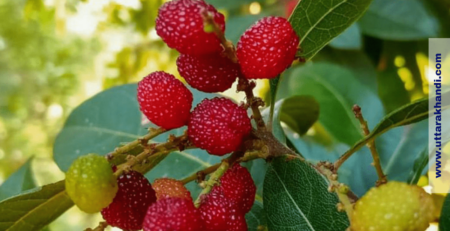
Kaafal, also known as the Himalayan Bayberry, is a fruit cherished by people of all age groups across the Kumaon and Garhwal regions of Uttarakhand. Bright red in color, Kaafal grows on an evergreen subtropical tree found in the forests of Uttarakhand and Nepal. Scientifically known as Myrica esculenta, Kaafal is prized not only for its tangy taste but also for its medicinal properties.
The fruit ripens in the month of Chaitra (mid-March to April). The Kaafal tree is similar in size to a mango tree, while its fruit resembles a small berry, about the size of a lemon seed. Rich in vitamins and antioxidants, Kaafal is deeply intertwined with local folklore, passed down through generations via oral storytelling.
The Legend
In a remote Kumaoni village lived a mother and her daughter, struggling to make ends meet. Their primary livelihood came from collecting and selling seasonal fruits in the nearby market. As spring approached and the forests lit up with ripened Kaafal, the mother gathered a large basket of the fruit and set off to collect grass and fodder for their cattle.
Before leaving, she called her daughter and said,
“Keep an eye on this basket of Kaafal. Don’t let anyone touch it. I’ll reward you when I return.”
The juicy, red berries glistened under the afternoon sun, tempting the young girl. Yet, she remained loyal to her mother’s word and resisted the urge to eat even a single fruit. Eventually, she dozed off in the heat of the afternoon sun. Meanwhile, the sun’s intensity caused the berries to shrivel slightly, making the basket appear half-empty. When the mother returned, she was shocked to see the reduced quantity of Kaafal. Mistaking it for her daughter’s disobedience, she lost her temper. Without asking a question or seeking an explanation, she struck her daughter in a fit of rage.
The fragile girl couldn’t withstand the blow. She collapsed and tragically, passed away.
As night fell and the cool mountain breeze rolled in, the Kaafal berries plumped up again, restoring their original appearance. Realizing the truth, the mother was devastated. The weight of her guilt became unbearable. She cried inconsolably, and overcome with grief, she too passed away soon after.
The Eternal Echo
It is believed that since then, every year during Chaitra, when Kaafal ripen, two birds are heard singing deep in the forests of Uttarakhand never seen, only heard.
One bird cries:
“Kafo pako, main ni chakhyo.”
“The Kaafal ripened, but I did not taste them.”
The other responds:
“Purray putayi, purray pur.”
“The basket is full, my beloved child, it is full.”
These hauntingly beautiful calls are said to be the voices of the mother and daughter forever echoing their sorrow and unfulfilled love.
Moral of the Tale
This folktale carries profound life lessons:
-
Anger is destructive – Decisions made in anger can lead to irreversible loss.
-
Think before you act – Always verify the truth before reacting.
-
Trust is the foundation of love – Relationships thrive on trust and patience.
Cultural Significance
Kaafal is more than just a fruit in Uttarakhand it’s a symbol of longing, loss, and maternal love. The story of the Kaafal birds is deeply rooted in Kumaoni folk culture and is retold through generations.
-
Reflects emotional depth – A tale of misunderstanding and regret
-
Marks the changing season – Kaafal ripening signifies the arrival of spring
-
Celebrated in rituals and folklore – The fruit and the tale are often referenced in festivals and folk songs
Even today, when the Kaafal ripen and the winds hum through the forests, locals pause and listen for the timeless echo of the mother and daughter – reminders of love, loss, and lessons that never fade.
3. Chal Tumadi Baatu Baat: A Tale of Two Witty Women
Once, in a remote village nestled in the hills of Uttarakhand, lived an old widow named Rami. She was known for her intelligence, courage, and sharp wit. It was the month of Chaitra (March–April), a time when households prepared to visit their married daughters to present them with Bhitauli a traditional gift symbolizing love and care.
Usually, brothers visit their sisters’ marital homes to present Bhitauli. But Rami, being a single mother, had kept this custom alive in her own unique way. She prepared a basket full of seasonal produce, including pahadi sweets like Singodi and Baal Mithai, woolen clothes, fruits such as Kaafal, and grains like Maduwa and Jhuwaar. With her basket on her back, she set off through the dense and dangerous forest to her daughter’s home.
The Bear in the Forest
As Rami entered the forest, she was confronted by a wild bear, who threatened to devour her. Terrified but quick-thinking, Rami decided to trick the bear. She said:
“Chelik ya jyul, doodh malai khool, tab tu maike khe liye!”
“I’m going to my daughter’s home. There I’ll drink rich milk, grow plump, and become tastier. You can eat me then.”
Tempted by the idea of a better meal, the bear let her go but warned her not to deceive him. Rami heaved a sigh of relief and continued her journey. She reached her daughter’s home safely and spent two joyous days there.
The Magical Tumadi
When it was time to return, she remembered her promise to the bear. Noticing her mother’s anxious face, the daughter asked what was wrong. Upon hearing Rami’s story, the daughter, who knew a few magic tricks, came up with an idea.
She took a large tumadi (bottle gourd), hollowed it out with a spell, and packed it with some food and a packet of red chili powder. Then, she helped her mother climb inside the tumadi. She chanted another spell that made the tumadi roll through the forest on its own.
As it rolled along the forest path, the waiting bear saw the strange sight and, puzzled, called out:
“Hey! Have you seen an old woman pass by?”
The tumadi responded with a voice from within:
“Chal tumadi baatu baat, mai ki jaanu budiya baat!”
“Let this bottle gourd roll its way—how would I know of any old lady?”
Confused and unsure, the bear let it pass.
The Escape
Soon, the tumadi was surrounded by a group of wild animals, curious and hungry. They tore it open, revealing Rami inside. Without panicking, she climbed a nearby tree and, using the chili powder, threw it into the animals’ eyes. Taking advantage of the chaos, she ran swiftly and finally reached home safe and sound.
The Wisdom of Rami and Her Daughter
This tale of Rami is often narrated to children in the Kumaon region to inspire them with the values of:
-
Quick thinking in adversity
-
Faith in oneself
-
Problem-solving with wit and calmness
Cultural Significance of Bhitauli and Tumadi
Bhitauli is a cherished festival in Uttarakhand, celebrating the emotional bond between a married woman and her natal family. The word comes from “Bhet”, meaning “meeting” or “visit.” Since married women often find it hard to return to their parental homes due to distance or circumstances, Bhitauli became a symbolic occasion of reunion.
-
Tumadi, a type of bottle gourd found only in Kumaon, is often included as a gift during Bhitauli. It holds a magical place in folklore, symbolizing cleverness and transformation.
-
The visit also honors the in-laws, strengthening family ties and harmony.
-
Bhitauli is celebrated in the month of Chaitra, when the snow begins to melt and the air turns pleasant, making long mountain journeys manageable.
Nature and Culture in Kumaoni Folktales
Kumaoni folk stories beautifully blend nature and culture, carrying profound meaning.
-
Oral storytelling is an age-old tradition where grandparents pass on cultural knowledge, myths, and values to children.
-
Natural elements like birds, trees, fruits, and rivers are used symbolically to represent emotions, struggles, and resilience.
-
Folk tales highlight the hardships of Pahadi life, instilling perseverance and courage in the younger generation.
-
The calls of birds like Ghughuti and Lam-puchad (Taiwan Blue Magpie) are believed to be voices of ancestors or divine beings, sharing wisdom through song.
Preserving the Culture
These folk stories are not just bedtime tales they are living pieces of heritage. Writers, poets, and singers from Uttarakhand continue to weave these narratives into their works, helping preserve the identity of the Kumaoni, Garhwali, Jaunsari, and Bhotiya tribes. Notable storytellers and singers have captured the essence of their motherland – its joy, struggle, magic, and love through their words, songs, and stories.
Frequently Asked Questions (FAQs)
What does the phrase “Chal Tumadi Baatu Baat” mean and how is it used in the story?
The phrase “Chal Tumadi Baatu Baat” is a playful and clever line used by the bottle gourd (magically speaking in the story) to confuse the bear. It means “Let this bottle gourd go on its way; how would I know anything about an old woman?” This line is central to the story’s humor and wit, showing how intelligence and trickery are used to escape danger.
Why is the festival of Bhitauli significant in the culture of Uttarakhand?
Bhitauli is a meaningful tradition in the hills of Uttarakhand that symbolizes the love and connection between a married woman and her birth family. It’s celebrated during the month of Chaitra (March–April), when the weather becomes pleasant enough for travel. This occasion allows family members -especially brothers to visit their married sisters and present gifts such as clothes, sweets, and grains. It represents emotional support and reinforces family ties.
Who are the main characters in this folk tale and what do they represent?
The story centers around Rami, an elderly widow, and her daughter. Rami symbolizes courage, experience, and presence of mind, while her daughter represents intelligence, resourcefulness, and the use of wisdom inherited from ancestors. Together, they highlight the strength of women and the power of familial bonds in overcoming challenges.
What important life lessons does this story convey to readers and children?
This folk tale teaches children to face difficult situations with a calm and clever mindset. It emphasizes the value of quick decision-making, using intelligence over brute strength, and the importance of staying positive in tough situations. It also showcases the power of unity and trust between family members.
Is the story based on true events or is it a fictional folk tale?
This is a fictional folk tale that has been passed down through oral tradition in the Kumaon region of Uttarakhand. It may not be based on real events, but it holds cultural truth and significance, offering moral lessons and insight into the lifestyle and beliefs of the Pahadi people.
What is a Tumadi and why is it important in the story?
A Tumadi is a type of bottle gourd native to the Kumaon region. In the story, it is magically hollowed out and used as a disguise to help Rami escape the bear. The Tumadi becomes a symbol of cleverness and tradition, showing how natural elements are often given magical importance in folk tales.
Which traditional Kumaoni sweets are mentioned in the tale and what do they represent?
The story mentions Singodi and Bal Mithai—two iconic sweets from the region. Singodi is made of coconut and wrapped in Malu leaves, while Bal Mithai is a chocolate-like sweet covered with white sugar balls. These sweets are often prepared for festivals and special occasions, representing joy, heritage, and celebration in Kumaoni culture.
Why is oral storytelling an important part of Kumaoni tradition?
Oral storytelling plays a vital role in preserving the identity, wisdom, and culture of the Kumaoni people. Grandparents and elders pass down folk tales to the younger generation, embedding values, history, and lessons in entertaining narratives. These stories keep the language, biodiversity, and spiritual beliefs of the region alive.
The folk tales and cultural songs of Kumaon like Ghughuti Basuti, Kafal Pakyo, Main Ni Chakhyo, and Chal Tumdi Baat Baat—are not just stories or lullabies; they are the heartbeat of a region deeply connected to nature, tradition, and community. These narratives celebrate the simplicity of life, the warmth of family bonds, and the intelligence and bravery that define pahadi spirit. Each story holds a deeper meaning. Ghughuti Basuti teaches love and celebration of children. Kafal Pakyo sings of longing, honesty, and justice. Chal Tumdi Baat Baat is a tale of wit, courage, and a mother’s clever survival. Through these, generations have learned values, remembered festivals, and stayed rooted in their identity. These stories are not only literary gems but living traditions sung by grandmothers, enacted by villagers, and cherished by children. They carry the fragrance of the hills, the song of the forests, and the wisdom of ancestors. By preserving and sharing them, we do more than honour our past we gift our future a sense of belonging, pride, and cultural depth.
Kumaoni folk stories, in their humor, melody, and message, remain timeless. They are the threads that weave hearts together from one mountain home to another.