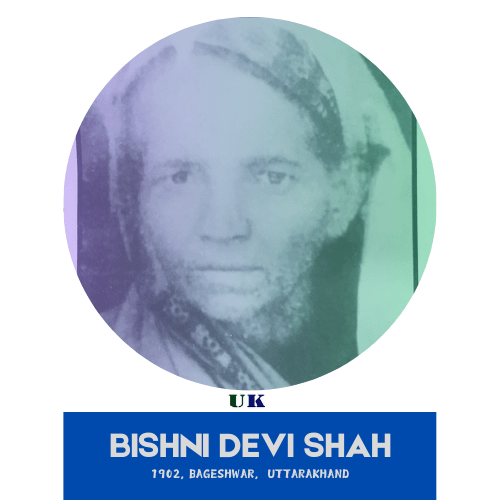
Bishni Devi Shah
Uttarakhand First Female Freedom Fighter and Social Reformer
Bishni Devi Shah (12 October 1902 – 1972) stands as a remarkable figure in Indian history, celebrated as the first woman from Uttarakhand to be jailed for participating in the independence movement. Her life story is one of resilience, courage, and an unwavering commitment to the ideals of freedom and self-reliance. Despite facing personal hardships and societal stigmas, she emerged as a beacon of hope for women and a stalwart in India’s struggle for independence.
Early Life: A Journey Marked by Challenges
Born on October 12, 1902, in Bageshwar, Bishni Devi’s early years were marked by trials that shaped her resolve. She received formal education only up to the fourth grade, reflecting the limited opportunities available to women in rural India during that era.
Married at the tender age of thirteen, her life took a tragic turn when she was widowed just three years later. As a young widow, Bishni Devi faced the double burden of personal loss and societal ostracism. Both her in-laws and her own family turned away from her, rendering her an outcast. Yet, instead of succumbing to despair, she chose a path of purpose, channeling her hardships into a relentless quest for justice and social reform.
Involvement in India’s Freedom Struggle
Bishni Devi Shah became actively involved in India’s freedom movement during her time at the Nanda Devi Temple in Almora. The temple, a hub of political discussions and gatherings, became the backdrop for her initiation into activism. She contributed to the movement in unique ways, motivating and honoring freedom fighters heading to jail. Her rituals of presenting flowers and performing aarti for the activists symbolized respect and encouragement for their sacrifices.
Her role extended beyond symbolic gestures. Bishni Devi discreetly collected funds to support the families of incarcerated activists and sang patriotic songs inspired by Kumaoni poet Gorda, whose works highlighted pressing issues like untouchability and superstition. Her efforts demonstrated a keen understanding of the intertwined nature of social reform and political freedom.
The Historic Protest of May 25, 1930
One of Bishni Devi’s most notable acts of defiance occurred during the Salt Satyagraha movement on May 25, 1930. A group of volunteers, including women, decided to hoist the national flag at the Almora Nagar Palika—a direct challenge to British authority. Despite facing brutal opposition from British soldiers, Bishni Devi and her compatriots, including Durga Devi Pant and Tulsi Devi Rawat, courageously raised the flag.
The act led to a violent confrontation, injuring prominent leaders like Mohanlal Joshi and Shantilal Trivedi. Bishni Devi’s unwavering resolve in the face of adversity made her a target of the colonial administration, leading to her arrest and imprisonment in Almora.
Promoting Swadeshi and Khadi
After her release, Bishni Devi became a staunch advocate of Swadeshi ideals. Recognizing the economic exploitation perpetuated by British rule, she actively promoted Khadi, a symbol of self-reliance and resistance.
At a time when there was a scarcity of volunteers to distribute Swadeshi products in Almora, and shopkeepers inflated prices, Bishni Devi took it upon herself to sell charkhas (spinning wheels) door-to-door at reduced prices. While the market price was ten rupees, she sold them for just five rupees to make them affordable. Her efforts weren’t limited to sales—she educated women on spinning Khadi, empowering them with the skills to contribute to the independence movement and achieve economic independence.
Her leadership abilities came to the fore when she was elected as the women’s manager of the Congress committee in Almora under Hargovind Pant’s leadership. Despite being arrested again in 1931 for her continued resistance, Bishni Devi remained undeterred, tirelessly working to rally people against British rule.
A Champion of Women’s Empowerment
Bishni Devi Shah’s activism extended beyond the political realm into social reform. She understood the critical role women could play in the freedom movement and sought to empower them through education and economic independence. By teaching women to use the charkha, she not only promoted Khadi but also fostered a sense of self-reliance among the rural population.
Her actions were rooted in the belief that freedom was not just about political independence but also about dismantling societal injustices and creating opportunities for marginalized groups, including widows and women from lower socio-economic backgrounds.
Legacy: Honoring a Forgotten Heroine
Bishni Devi Shah’s contributions to India’s freedom struggle and her efforts to uplift society remained largely unacknowledged during her lifetime. However, her legacy has gained recognition in recent years.
In 2021, the Indian Postal Department paid tribute to her by featuring her photograph and biography on postal envelopes. This initiative was a significant step in ensuring that her sacrifices and contributions are remembered and celebrated.
Her life serves as an enduring inspiration, highlighting the critical role women played in the freedom movement. Bishni Devi Shah exemplifies the spirit of resilience, courage, and the transformative power of grassroots activism.
A Legacy of Courage and Compassion
Bishni Devi Shah’s story is one of extraordinary determination and selflessness. From her early struggles as a marginalized widow to her fearless activism in the face of colonial oppression, she remains a symbol of courage and resilience. Her efforts in promoting Khadi, empowering women, and defying British rule have left an indelible mark on Indian history.
As we reflect on her life, Bishni Devi Shah’s journey reminds us of the countless unsung heroes whose sacrifices paved the way for India’s independence. Her legacy inspires us to uphold the values of justice, equality, and self-reliance in our own lives.