Tungnath
Mythological Significance and Religious Importance of Tungnath Temple
The mythology of Tungnath Temple is closely connected to the epics of the Mahabharata and Ramayana. As one of the Panch Kedar temples, it is dedicated to Lord Shiva and linked to the penance of the Pandavas. After the battle of Mahabharata, the Pandavas felt deeply guilty for killing their own relatives. To atone for their sins, they decided to worship Lord Shiva.
The Pandavas’ Attempt to Seek Forgiveness from Lord Shiva
Lord Shiva was angry with the Pandavas and did not want to forgive them, so he disguised himself as a bull and hid in the Himalayas. The Pandavas wandered through the challenging Himalayan mountains in search of Lord Shiva. Eventually, Shiva’s body parts appeared at five different places, which are now known as the Panch Kedar temples.
Tungnath is the third of the Panch Kedars, where Lord Shiva’s hand emerged. Other parts of his body manifested in Kedarnath, Rudranath, Madhyamaheshwar, and Kalpeshwar, which are also revered as holy sites.
The Emergence of Lord Shiva’s Body Parts and Panch Kedar
After Lord Shiva’s body went underground, his parts emerged in five different places. The Pandavas built temples at each location, now known as the Panch Kedar:
- Kedarnath – Here, Lord Shiva’s hump appeared.
- Tungnath – Here, Lord Shiva’s hand emerged, and thus it is called Tungnath. “Tung” means hand, and “Nath” refers to Lord Shiva.
- Rudranath – Here, Lord Shiva’s head appeared.
- Madhyamaheshwar – Here, Lord Shiva’s navel appeared.
- Kalpeshwar – Here, Lord Shiva’s hair emerged.
Architecture and Natural Beauty of Tungnath
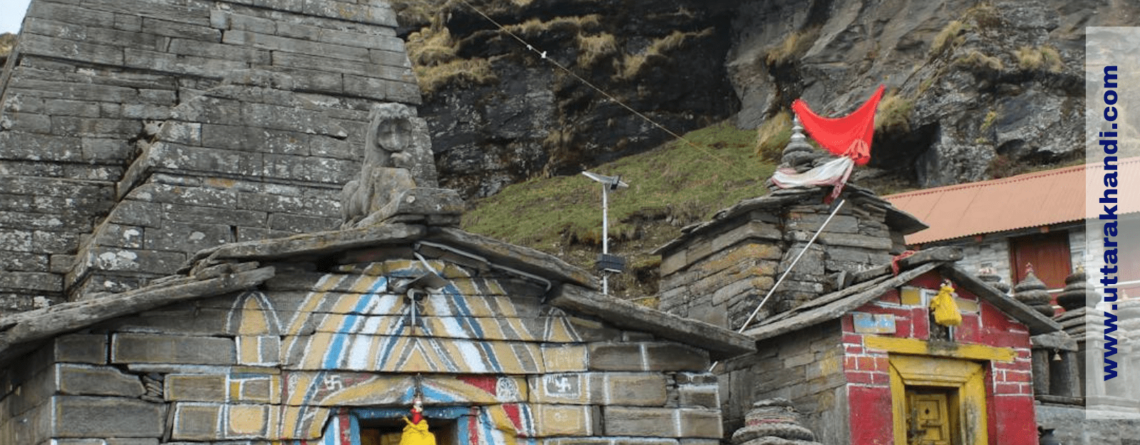
Located at an altitude of approximately 12,073 feet, Tungnath is considered one of the highest Shiva temples in the world. The temple is built entirely from stone and is surrounded by breathtaking natural beauty. From here, one can witness stunning views of the snow-capped peaks of the Himalayas.
The Importance of Lord Ram and Chandrashila
Another significant mythological story related to Tungnath involves Lord Ram. According to the Ramayana, after slaying Ravana, Lord Ram sought to rid himself of the sin of Brahmahatya (the killing of a Brahmin). He traveled to the Himalayas and meditated at Chandrashila, a peak located about 1.5 kilometers from Tungnath at an altitude of around 14,000 feet. Chandrashila offers a magnificent view of the towering Himalayan ranges and remains a center for meditation and spiritual practice.
Experience of the Tungnath Pilgrimage
The pilgrimage to Tungnath and Chandrashila is a unique blend of religious devotion and natural beauty. Devotees embark on this journey amidst the challenging climbs and serene landscapes of the Himalayas. The trek to Tungnath begins at Chopta and covers approximately 4 kilometers, passing through lush meadows, dense forests, and picturesque valleys.
The journey not only offers spiritual fulfillment but also provides an opportunity to experience the tranquility and scenic splendor of the Himalayas.