Mola Ram

Mola Ram
(1743–1833)
Mola ram was born in Uttarakhand in 1743. He was a painter in the 16th century Uttarakhand at the time of the garage empire. His father’s name was Mangat ram and his mother’s name was waa s ram, Devi. His ancestor was also a painter but mainly they were goldsmith. He was the most famous painter in his family. He was not only a painter but also a poet, philosopher and historian. Mola ram’s teacher was ram Singh or His sons’ names were jwalaram and Shivam. His ancestors help in the progress of the Mughal genre. His grandfather’s name was Heera Lal. He learnt painting from him. He also knew Hindi, English, San skrit and Persian. Mola ram died in 1833.
Indian painter Mola Ram, also known as Maula Ram (1743–1833), founded the Garhwal branch of the Kangra style of painting. He was also a poet, historian, and diplomat. Mukandi Lal conducted a significant amount of study on him. He was the son of Mangat Ram and Rami Devi and was born in Srinagar, which is today in Uttarakhand.
He had the protection of these Pawar kings:-
- Pradip Shah
- Raja Lalit Shah
- Jaykrit Shah
- Pradyuman Shah
- Sudarshan Shah
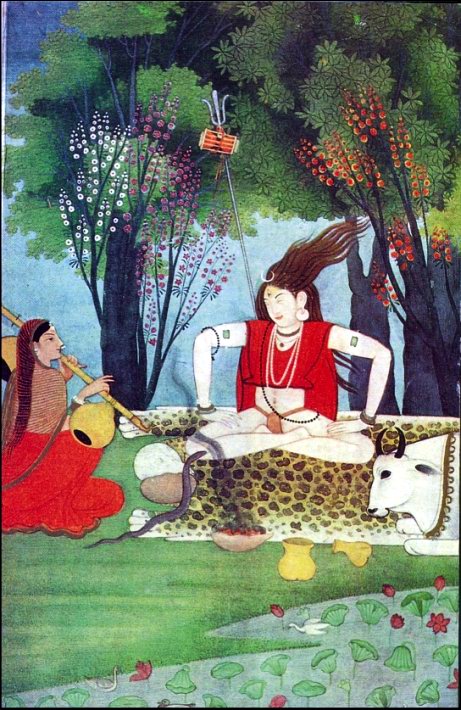

Famous Paintings
- Radhakrishan Milan
- Govardhan Dharan
- Chandramukhi
- Hindola
- Chakor Priya
- Mayank Mukhi
- Mahadev Parvati
- Koliya Daman
- Mor Priya
- kadali Priya
- Sitaarpriya
His painting, which is known as Agarwal painting, can be seen in the most famous art gallery Boston museum. J.C French also mentioned his name in his book ‘Himalayan Art’. King Jaykrit Shah always supports molaram and he also gives 60 estates and 5 rupees per day wage to mola ram.
Mola ram also lived with Raja Sansar Chand but for some time. Mola ram’s student name was chest and makeup. Kunwar Pritam shah travels from there to Srinagar to learn painting from molaram. Mola ram also did a Hindi translation of ‘Abhigyanshakuntalam’.
He was born in the Pauri Garhwal district in Srinagar, which is currently in Uttarakhand . He was the son of Mangat Ram and Rami Devi. From 1777 until the Garhwal Kingdom’s invasion by the Gorkhas in 1803 and the British Raj in 1815, he served the Garhwal Kingdom, under the suzerainty of Maharajas Pradeep Shah, Lalit Shah, Jaikrit Singh, and Pradyuman Shah. Under both British and Gorkha administrations (1803–15), he kept pushing for the advancement of the arts and literature. He has earned a place in Uttarakhand history for his contributions to painting and art, and he passed away in 1833.
Earlier to moving to Kangra, Mola Ram painted in the Mughal style before moving to Kangra, such as , in his painting Mastani , but his subsequent works, like Vasakasajja Nayika, are in the Garhwali style and may be considered a genuine Garhwali painting. He has autographed several of his works of art. He has published the historical work , Garth Rajvansh Ka Itihas (History of the Garhwal Royal Dynasty), which is the only publication that has information on a number of the Garhwal emperors. Shyam Shah is mentioned initially, followed by descriptions of Dularam Shah, Mahipati Shah, Pritam Shah, Medini Shah, Lalit Shah, and Jayakrit Shah.
In 1800, he also produced Ganika Natak, also known as Garh Gita Sangram. In order to put down a revolt in the Battle of Karparoli, Jayakrit Shah needed the assistance of Raja Jagat Prakashof Sirmur, who was provided by Mola Ram himself. Along with Garhrajvanshkavya, a few other works of Mola Ram are Ran Bahadur Chandrika, Shamsher-e-Jang Chandrika, and Bakhtawar Yash Chandrika.
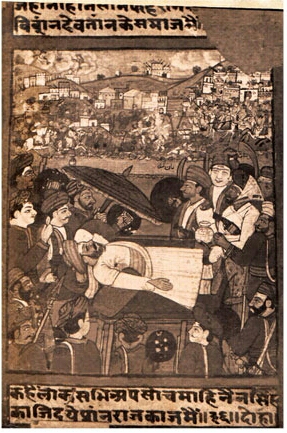
Poem and portrait of event of death of Kaji Nain Singh Thapa in 1804-06 Gorkha conquest of Garhwal, by Poet Mola Ram
In 1867 V.S. (i.e., 1810 A.D.), when Kaji Bakhtawar Singh Basnyat came to Srinagar, Mola Ram gave a description of the Gorkhali government since that year (i.e., 1804 A.D.). Kaji Bakhtawar donated 61 gold sovereigns, a horse, a robe, and some weapons, and returned his jagir villages and daily allowances as a token of appreciation for Mola Ram’s labours. Kaji Bakhtawar Singh Basnyat was honoured by Mola Ram when he dedicated Bakhtawar Yash Chandrika. In his other work, Garhrajvanshkavya, he discussed the past, present, and future of the Gorkhali government in Kumaon and Garhwal and predicted the Gorkhali government’s potential fall.
An instance of Mola Ram For his contribution to art and painting, Mola Ram has earned a place for himself in Uttarakhand’s history.From 1777 until 1804, Mola Ram was employed by the dynasties of Maharaja Pradeep Shah, Maharaja Lalit Shah, Jaikrit Singh, and Maharaja Pradyuman Shah. Throughout the Gorkhas’ (1803–15) and British-era reigns, he kept pushing for the advancement of literature and art. In 1833, Mola Ram passed away in Srinagar.
Mola Ram’s paintings have been preserved in a number of locations. The HNB Garhwal University Museum in Srinagar has a sizable collection, and some are also on display at the Boston Museum of Fine Arts in the United States. Many of his paintings are also in private collections. Some of these are on display at the Kastur Bhai Lal Bhai Sagrahaalaya in Ahmedabad and the Bharat Kala Bhawan in Banaras, while others are at the art museums in Delhi, Lucknow, Calcutta, and Allahabad.
In 1968, Barrister Mukandi Lal published a fascinating book titled “Garhwal Painting,” which is thought to have his numerous paintings published therein. This is regarded as the restoration of the “Garhwal School of Painting,” restoring the fame of Mola Ram and Garhwal Paintings to the world. Some of the major masters of this school of painting included Jwalaram, Tejram, and Brijnath; they were all members of the Mola Ram family.
Mukundi Lal
Most of the research about him was done by Mukundi. The genre of Uttarakhand’s paintings was founded by Mukunda Lal in the 20th century. He wrote books about molaram like ‘some notes on molaram’, ‘Agarwal paintings’and’garwal school paintings’.
Tribute and Memorials
Mola Ram’s paintings have been preserved in a number of locations. The HNB Garhwal University Museum in Srinagar has a sizable collection, and some are also on display at the Boston Museum of Fine Arts in the United States. Many of his paintings are also in private collections. Some of these are on display at the Kastur Bhai Lal Bhai Sagrahaalaya in Ahmedabad and the Bharat Kala Bhawan in Banaras, while others are at the art museums in Delhi, Lucknow, Calcutta, and Allahabad.
And a tributary, “Garhwal Painting,” was published in the form of an intriguing book in 1968 by Barrister Mukandi Lal, which is regarded as the resuscitation of the “Garhwal School of Painting” and brought Mola Ram’s and Garhwal Paintings’ fame to the world once again. Some of this school’s notable masters included Jwala Ram, Tejram, and Brijnath, all of whom were Mola Ram ancestors.