GAURA DEVI

BACKGROUND OF GAURA DEVI [ 1925 – 1991 ]
Belonging to a tribal family, Gaura devi was born in 1925 in the Lata village of Chamoli district of Uttarakhand. She got married and shifted to her in-law’s home in a nearby village named Reni. She was only 12 years old when she got married to Meherban Singh, a farmer who also did sheep rearing and trading of wools. After 10 years of marriage when Gaura was only 22 years old, her husband died, leaving her with the responsibility of raising their infant child alone.
Her courage and determination were perceived by the people of her village since even after facing many issues and complications, she was determined to run her household adequately. At fellow village women’s request, Gaura devi was made the head of Mahila Mangal Dal. Their main objective was to promote cleanliness and the prevention of forests in the village.

CHIPKO MOVEMENT
A movement with non-violent attitudes, the chipko movement was initiated in the 1970s concentrated on the prevention of trees falling in large numbers. It was the mobilization of women from all over the places of Uttarakhand that played a major role during the chipko movement.
Gaura Devi’s efforts are credible for the absolute participation of women in the movement. In 1974, the government sanctioned the cutting down of trees in Reni village. Since tree protection movements were already widespread among people, they planned to lure the men of Reni village out of the village in the name of some form of compensation. As soon as Gaura devi got the news about contractors heading towards the forest to cut down the trees, she instantly gathered village women and fearlessly moved towards the forest. She tried to confront the labor men there to convince them not to cut the trees. Yet, the contractors and labourers didn’t pay any attention to her. They started pointing guns at the women with the thought of scaring them away, but the women were determined enough in the leadership of Gaura devi.
They kept their own lives at stake, and hugged the trees, challenging labourers to kill them before cutting down trees. Eventually, contractors had to back off. This strength demonstrated by Gaura devi motivated women all across the state and many other places to come forward, taking their stands firmly. Gaura devi continued participating in movements prohibiting the exploitation of nature.
Following the turmoil commenced by Gaura devi, women of villages like Gopeshwar, Bhyundar Valley, etc. came forward and actively participated in the protection of nature. One such incident involved Dongari and Paitoli, where the women of the village defied the construction of a horticulture farm. The construction would have led to the cutting down of around 60 acres of Oak forest. Now, women also demand an equal voice while taking judgments regarding nature.
IMMEDIATE EFFECT
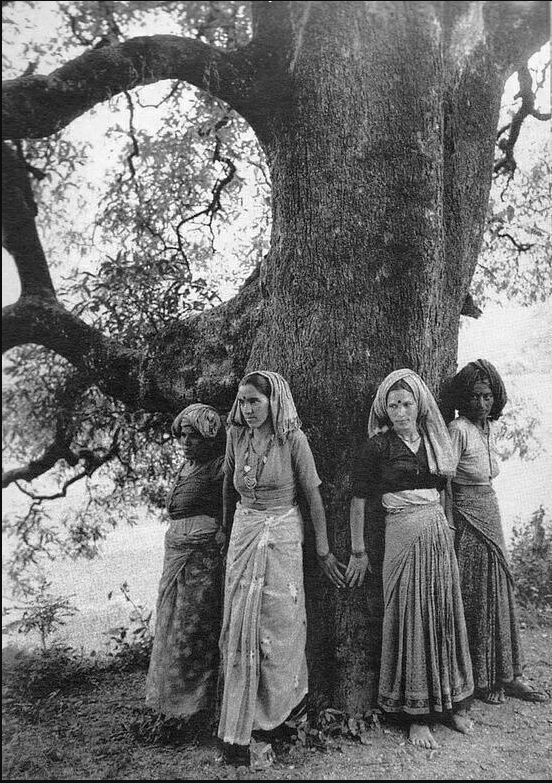
As an impact of the movement government imposed a 10 – year ban on cutting down trees in the area of around 1150km. Also a committee was established to look into the large felling down of trees.
Her extreme love and affection for nature have been an example for many. She is often considered as modern-day “Jhansi ki Rani” in Uttarakhand and all around the world. She was honored with environment – friendly award in 1986. Unfortunately, after a long period of illness, Gaura Devi died at the age of 66 in July 1991. On 12 April, Union Environment Minister declared two awards for environment protection and one among them includes the Gaura Devi award. Her contribution to environmental development and the upliftment of women has been a significant mark on our history.
Even though Gaura Devi is not with us today, her tribute towards nature can never be forgotten. She is still told about generation after generation as the heroic woman popularly known as Chipko women. “This forest is like our mother’s house. From here we get fruits, flowers and vegetables. If you cut the trees and plants here, there will definitely be a flood”. Said by Gaura Devi.