Tilu Rauteli
The Fearless Warrior of Uttarakhand
Tilu Rauteli (born Tilottama Devi) is a legendary female warrior from the 17th century, celebrated in the history and folklore of Uttarakhand. Born in Gurrad Talla, Chaundkot, in the Pauri Garhwal district, she remains a symbol of courage, resilience, and the indomitable spirit of women. Known for fighting seven battles between the ages of fifteen and twenty, her story transcends the battlefield, becoming an enduring tale of sacrifice, leadership, and determination.
Early Life
Tilu Rauteli was the daughter of Bhoop Singh Rawat (Gorla), a respected figure in Garhwal, and had two brothers, Bhagtu and Pathwa. Raised in a tumultuous time when the Katyuri warriors of Kumaon frequently invaded the Garhwal Kingdom, she grew up in an environment where survival often meant warfare.
At just fifteen, she was engaged to Bhuppa Singh Negi of Ida Talla village, and life seemed to promise peace and happiness. However, destiny had other plans. The Katyuri warriors killed her father and brothers in a series of battles, leaving her family devastated. The grief-stricken Tilu sought solace in her mother’s guidance, only to be met with words that would ignite her warrior spirit:
“O Tilu! What are you! Don’t you miss your brothers? Who will avenge your father’s death? If you want to go somewhere, it should be the battlefield… Can you go? Can you avenge…? Enjoy your Kauthig (festival) after that!”
These words became her call to action. Tilu Rauteli set aside her personal desires, including attending the local Kauthig (fair), and embraced her destiny as a warrior.
The Warrior’s Journey
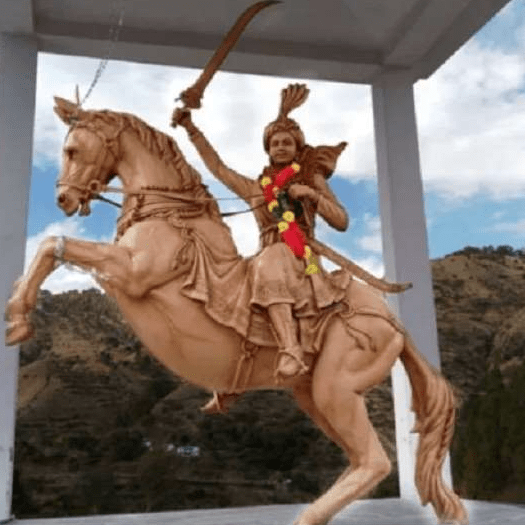
Tilu gathered her childhood friends Bellu and Devali, and with her loyal horse Binduli, she began preparing for war. She regrouped a small army of loyalists and vowed to defend her homeland against the invading forces. Despite her youth, she displayed remarkable leadership and strategic acumen, rallying her forces and inspiring them to fight for their kingdom and honor.
Key Battles and Victories
Tilu Rauteli’s journey is marked by several decisive battles that demonstrated her unparalleled courage and military prowess:
- Battle of Khairagarh (Kalagarh)
Her first battle was in Khairagarh, where she led her forces against the Katyuri invaders. With her sharp strategy and fearless spirit, she defeated the enemy and secured the region for the Garhwal Kingdom. - Battle of Umtagarhi
Buoyed by her victory, Tilu marched to Umtagarhi, a critical stronghold of the Katyuri warriors. She launched a swift and decisive attack, reclaiming the territory for Garhwal. - Liberation of Sald Mahadev
Her next campaign was at Sald Mahadev, where she once again led her army to victory, freeing the sacred site from enemy occupation. - Battle of Kalinkakhal
Perhaps her most personal and significant battle was fought at Kalinkakhal, where her father had been killed by Katyuri forces. Tilu not only reclaimed the region but also avenged her father’s death by defeating the Katyuri general in Saraikhet, the very site of her father’s fall. However, this victory came with a heavy cost—her loyal horse Binduli was fatally wounded in the battle.
Through these victories, Tilu Rauteli extended the borders of the Garhwal Kingdom and solidified her reputation as a formidable warrior.
The Ultimate Sacrifice
After achieving her military objectives and reclaiming lost territories, Tilu began her journey back home. However, while resting near the Nayar River, she was ambushed by enemy forces. Despite her valiant efforts, she was overwhelmed and made the ultimate sacrifice for her land. Her death marked the end of a brief yet extraordinary life devoted to bravery, justice, and honor.
Legacy
Tilu Rauteli’s story is not just about battles; it is a narrative of unyielding determination, love for one’s homeland, and the strength of a woman who defied societal norms to lead armies and protect her people. Her legacy is deeply woven into the cultural fabric of Uttarakhand:
- Ranbhoot in Jagars: In traditional Jagars (spiritual folk rituals of Uttarakhand), Tilu Rauteli’s spirit is invoked as a symbol of bravery and resilience.
- Thadya Dance: The Thadya dance songs, performed during cultural celebrations, honor her achievements and keep her memory alive.
- Statues and Folktales: Across Uttarakhand, statues of Tilu Rauteli and local folk tales ensure that her story continues to inspire.
Her life has become a beacon of empowerment, particularly for women, showing that courage and leadership know no gender.
Cultural Significance
Tilu Rauteli’s tale is more than a historical account—it is a reminder of the enduring spirit of Uttarakhand’s people. Her story is a cherished part of Garhwali folklore, passed down through generations, reflecting the values of sacrifice, duty, and resilience.
ओ कांडा का कौथिग उर्योओतिलू कौथिग बोलाधकीं धे धे तिलू रौतेली धकीं धे धेद्वी वीर मेरा रणशूर ह्वेनभगतु पत्ता को बदला लेक कौथीग खेललाधकीं धे धे तिलू रौतेली धकीं धे धे
Even today, she is celebrated as an icon of strength, not just in Uttarakhand but across India, where her name resonates as a symbol of bravery and the fight for justice.